Wearable Data for Coaches: What's Real, What to Ignore
Your Wearable Tracks What It Can See, Not What Matters. Here's the Data Layer Clients Actually Need — and What to Ignore.
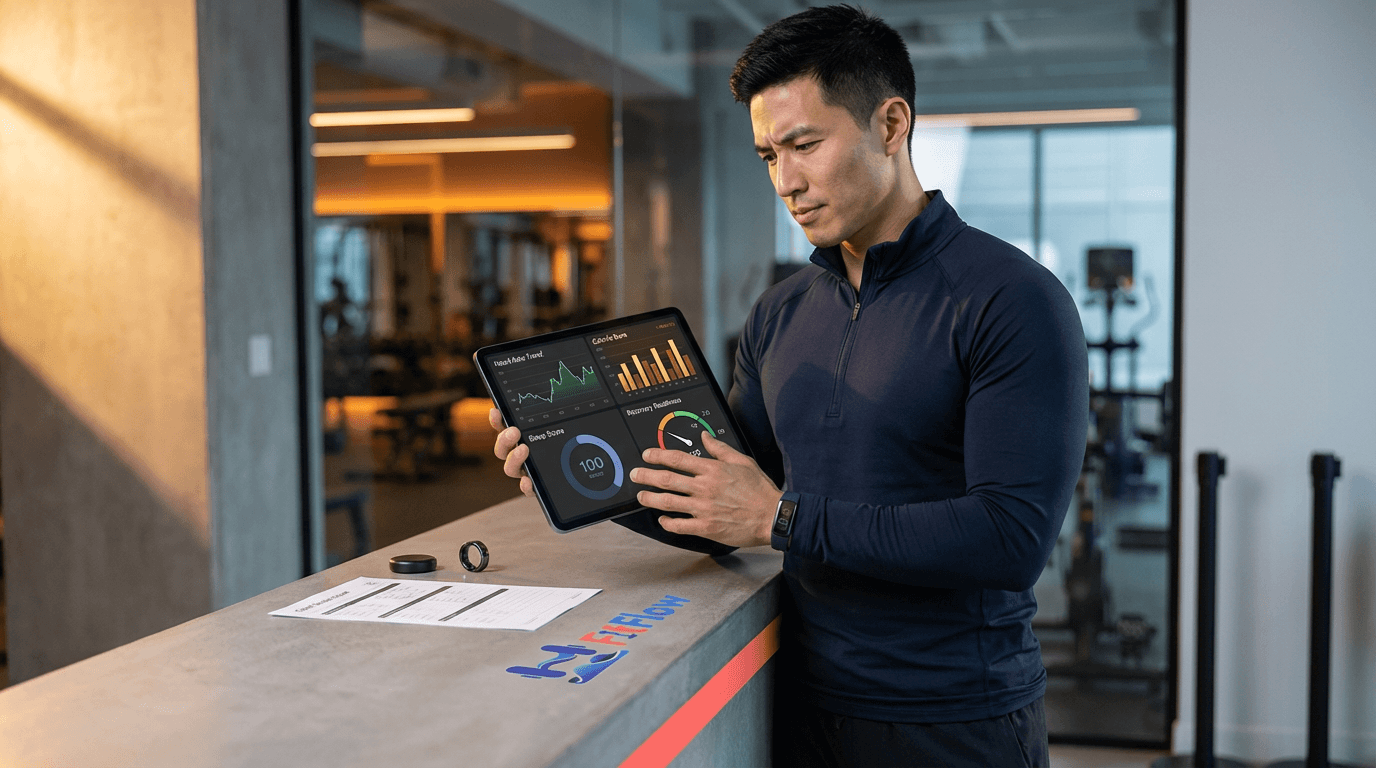
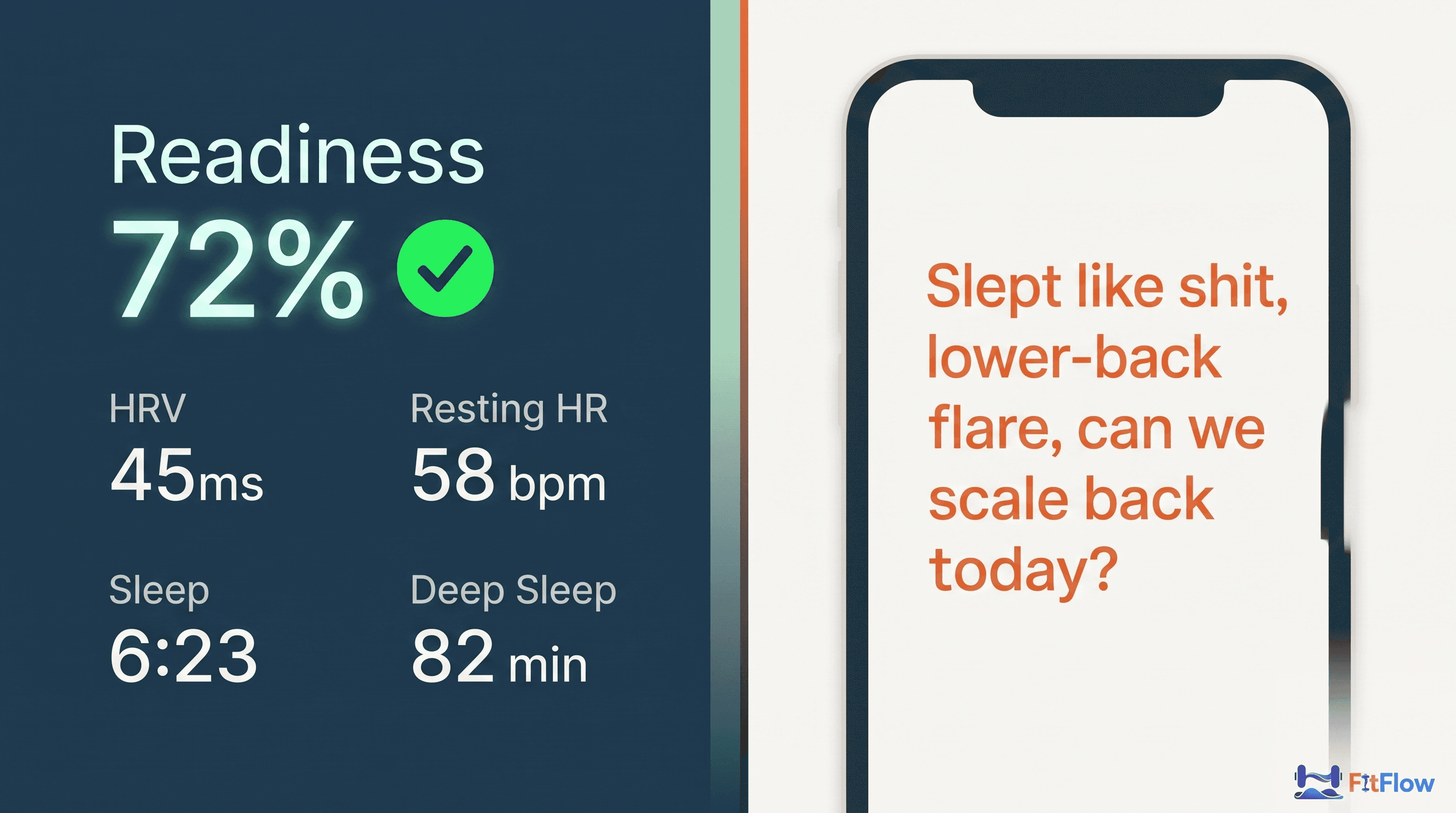
Imagine this scenario: A trainer pulls up their Oura data and sees readiness 72%, HRV 45ms, resting HR 58, sleep 6:23, deep sleep 82 minutes. The numbers look crisp. Precise. Actionable. Forty-five minutes later, the same client texts: "Slept like shit, lower-back flare, can we scale back today?"
One measurement came from a $300 ring. One came from lived experience. Only one was trustworthy.
This is the paradox that defines coaching in 2026: wearables capture more data than ever, but coaches understand their clients less. Apps have become more sophisticated; coaching judgment has regressed to marketing claims.
The problem isn't that wearables lie. It's that we treat their output as truth instead of signal. And that difference changes everything about how you should interpret what your clients bring to you.
The Paradox: Apps Know More About Your Clients Than Ever. Coaches Understand Less.
Wearable adoption has shifted from novelty to default. Your clients own Oura rings, Apple Watches, Whoop bands, Garmin devices. They've paid hundreds of dollars for devices that promise to predict their readiness, optimize their recovery, and unlock their potential.
And they're bringing that data to you.
The sophistication is real. Modern wearables integrate resting heart rate, heart rate variability, sleep stages, skin temperature, blood oxygen saturation, even blood glucose estimates. They triangulate across multiple sensors and machine learning. The algorithms are trained on millions of data points from millions of users. By the numbers, these devices are more capable than anything available to trainers five years ago.
Yet coaches report increasing confusion. Clients show them a readiness score and ask, "Can I train hard today?" Trainers see impressive HRV numbers and feel compelled to honor them. A client's sleep score drops from 87 to 62, and suddenly both trainer and client are anxious about whether recovery is actually broken.
Here's what's happening: Apps quantify what they can detect. They hide what matters most to coaching—why it's happening, what to do next, and whether to trust it.
When a client buys a $300 wearable, they're not actually paying for truth. They're paying for data ownership—the feeling that they understand themselves better. That's psychologically valuable and often motivating. But it creates a false sense of certainty. A sleep score of 84 looks precise. In reality, it carries ±20% noise. An HRV reading of 45ms looks actionable. That number is ±15ms measurement error, plus ±30–50% daily variation from hydration, caffeine, and stress alone.
Wearables have made measurement visible. They haven't made it reliable.
The framework for understanding this is coming. But first, let's be honest about what these devices actually do well.
What Wearables Are Genuinely Good At (And When to Trust Them)
Here's where I want to break against the skeptic take: wearables have real strengths. They're not charlatans, and dismissing them entirely abandons useful information.
Heart rate tracking is genuinely reliable. Modern wearables (Oura Gen3/Gen4, Polar H10, quality Garmins) measure resting HR with ±3–5% accuracy. Under load, expect ±8–12% error—still tight enough to reveal useful trends. The key phrase is relative trends. A client whose resting HR has crept from 58 to 68 over six weeks is signaling something (deconditioning, chronic fatigue, overtraining). The specific number—whether it's 58 or 61—matters less than the direction.
Peer-reviewed validation confirms this. Oura Gen3/Gen4 scored highest in independent testing for resting HR and HRV measurement at rest, while Polar H10 remains the gold standard for ECG-equivalent accuracy. These devices earn their reputation.
Movement counting is nearly flawless for walking and running. Step accuracy hovers around 95%—good enough for adherence tracking and basic activity monitoring. If a sedentary client suddenly moves from 4,000 to 8,000 steps daily, that's meaningful. It's also verifiable through lived experience: the client knows whether they've walked more.
Structured workout logging is 100% accurate if logged honestly. A client who logs "45 min, moderate intensity" into their device is giving you usable data—not because the device measured it, but because the client reported it. The value is in consistency and client accountability, not in sensor precision.
Trends over 4+ weeks reveal genuine patterns. A client's 30-day average heart rate, sleep duration, or step count aggregates noise and surfaces real direction. Day-to-day variation is too high to act on. Month-to-month trends are actionable. This is where wearables shine: they provide a data narrative your client can see across time. (For deeper guidance on long-term trend analysis in coaching, see our guide to periodization and trend spotting.)
Relative fatigue cues work when anchored to individual baseline. If this specific client's HRV typically hangs around 50ms and drops to 42ms, that for this person might signal something (stress, illness, poor sleep). The absolute number doesn't matter. The deviation from their normal does. Most coaches intuitively understand this but fail to build it into their data workflows.
Here's the honest boundary: wearables excel at measurement in isolation. HR? Yes. Steps? Yes. Sleep duration? Yes. What they fail at—consistently and deliberately—is interpretation, context, and translation to coaching action. They measure what they can. They hide what's harder to sell.
Which brings us to the other side of the coin.
What Wearables Hide, Guess, or Gamify (The Trust Section)
The problem with wearables isn't incompetence. It's that they present false confidence. A training load of 247 looks like physics. It's not—it's proprietary. A readiness score of 72% looks objective. It's not—it's a population average applied to your client.
Let me walk through the specific failure points that matter for coaching decisions.
The "Readiness" Algorithm Fallacy
This is where liability lives.
Most consumer wearables (Whoop, Oura, some Garmins) generate a "readiness" score by combining resting heart rate, heart rate variability, sleep duration, and sometimes skin temperature. The algorithm runs these inputs through proprietary weighting and outputs a number: 0–100. "Go hard" vs. "recover."
Here's what's hidden: HRV is the noisiest metric on the device. It swings ±30–50% day-to-day from hydration, caffeine consumption, stress, and measurement error alone. These variations have nothing to do with recovery status. A client who had two coffees and took a work call at 7 a.m. will show depressed HRV. The algorithm doesn't know this. It interprets low HRV as "low readiness" and outputs a low score.
Meanwhile, a stressed client with poor sleep might still score "high readiness" if their morning routine was calm and hydration was good. The algorithm has no idea about the underlying stress. It only sees the inputs it's designed to see.
The readiness score is trained on population averages, not your client's baseline. What Whoop learned across 500,000 users doesn't necessarily apply to your 40-year-old strength athlete. The algorithm doesn't adapt for sport, genetics, or individual response pattern.
And here's the liability: if you use a wearable's readiness score to clear a client for high-intensity training and they get injured, you bear professional liability. The wearable company does not. You made the coaching decision. The algorithm was an input—one you chose to trust.
This isn't the app's fault. It's the coach's job to know the inputs before trusting the output. But most coaches don't. They see a number and inherit its false confidence.
The Energy/Calorie Myth
Apps estimate TDEE and workout calorie burn by running your heart rate through proprietary VO2 max proxies. The accuracy is dismal.
General calorie burn estimation: ±15–55% depending on activity. Garmin's Firstbeat algorithm shows 6.7% error at medium-hard intensity but inflates resting calories by 15–20% across the entire day. Apple Watch runs 18–40% error across mixed activities. WHOOP hits 12% accuracy on steady cardio but jumps to 29% error on strength training.
Why? Because calorie burn depends on factors the wearable can't measure: muscle mass, metabolic efficiency, movement economy, temperature regulation, and the thermic effect of food. The app sees heart rate and activity type. It guesses everything else.
This creates a practical problem: clients build nutrition decisions off wearable calorie burns. A client burning 2,400 calories according to their Fitbit might actually be burning 1,900 or 2,800. If they're eating to match the Fitbit number, they're either in a deficit they don't expect or a surplus they don't account for.
As a coach, you have two choices: ignore the number or use it as a rough check-in point, never as law.
Sleep Staging Isn't Clinical
Wearables claim to measure deep sleep, light sleep, and REM stages. What they're actually doing is running actigraphy (movement tracking) and heart rate patterns through algorithms trained on polysomnography studies. It's educated guessing, not measurement.
Validation studies show ~60–75% accuracy for Oura against clinical polysomnography. But here's the hidden issue: one brand's definition of "deep sleep" doesn't match another's. Oura might call something slow-wave sleep; Garmin might call it deep sleep; Polar might score it differently. The stage names are standardized in sleep science, but the detection methods differ by device.
Real clinical validation (polysomnography) uses EEG, EOG, and EMG. It measures brain waves directly. Wearables use movement and heart rate—proxies for proxies. A client's "deep sleep" score is informational only. It should never drive coaching decisions about sleep quality or recovery status.
What you can trust: sleep duration trends. A client sleeping 5:30 for two weeks then 7:00 for two weeks shows a real shift. Whether those hours were "deep" or "light" is noise.
Heart Rate Zones from Formulas, Not Individuals
The 220-age formula for max HR is convenient and obsolete. It's ±12–15 bpm off for the average person—a range wide enough to put your client in zone 1 when you think they're in zone 2.
Apps don't tell you this. They calculate HR zones using the formula and present them as individualized. A client at 140 bpm might actually be zone 1 (70% of true max) or zone 3 (85% of true max) depending on their true max heart rate. The app shows one zone. Reality shows another.
The fix exists: LT testing, a 3-minute all-out test, or direct VO2 max testing. But apps don't offer it. It's harder to sell than a default formula. Coaches who want accurate zones must measure them, not inherit them from the device.
Calories Per Workout Inflated
A 60-minute "moderate intensity" workout shows as 400–500 calories burned. The actual number is often 250–350. Apps systematically overestimate to make clients feel like they've earned more. It's not malicious. It's motivational design.
This feeds back into nutrition. A client who believes they burned 450 calories eats 450 extra calories to "refuel." If they actually burned 300, they've just added 150 calories of surplus. Multiply that across weeks, and you have unexplained weight gain.
Streak Psychology as Retention Hack
Strava segments, Apple Rings, Fitbit streaks, and WHOOP's compliance streaks are gamified but not adaptive to actual recovery needs. A client grinding a 30-day streak through overtraining or missed deload windows doesn't get a coaching signal. The app rewards consistency, not wisdom.
More subtly: Whoop and Oura algorithmically increase readiness scores if compliance (app-checking behavior) drops. If a client hasn't logged sleep for three days, the next day might show artificially inflated readiness to re-engage them. This is retention optimization, not accuracy optimization. But coaches often don't know it's happening.
The Confidence Problem (Deepest Issue)
All of this rolls up into one core problem: apps present false precision.
A sleep score of 84 looks precise. It's actually ±20% noisy. HRV of 45ms looks actionable. It's actually ±15ms measurement error plus ±30–50% daily variation. A training load of 247 looks like it came from physics. It came from proprietary weighting you don't understand.
Trainers inherit this false confidence without knowing what inputs mean or how they're calculated. You see the output (a number) but not the uncertainty (±range). You treat correlation as causation. You act on noise you mistake for signal.
That confidence gap is where coaching quality breaks down.
You just read six ways the number can be wrong. Here's the pass that tells you which one you're looking at. The checklist pairs each marketing label — readiness, calorie burn, sleep stages, HRV, HR zones, training load — with the measurement underneath it, and grades it STRONG, WEAK, or NONE with the error range that puts it there. Download the Wearable Data Decision Checklist.
The "Detection → Interpretation → Decision → Delivery" Stack for Wearable Data
The fix isn't to abandon wearables. It's to own your role in the data chain.
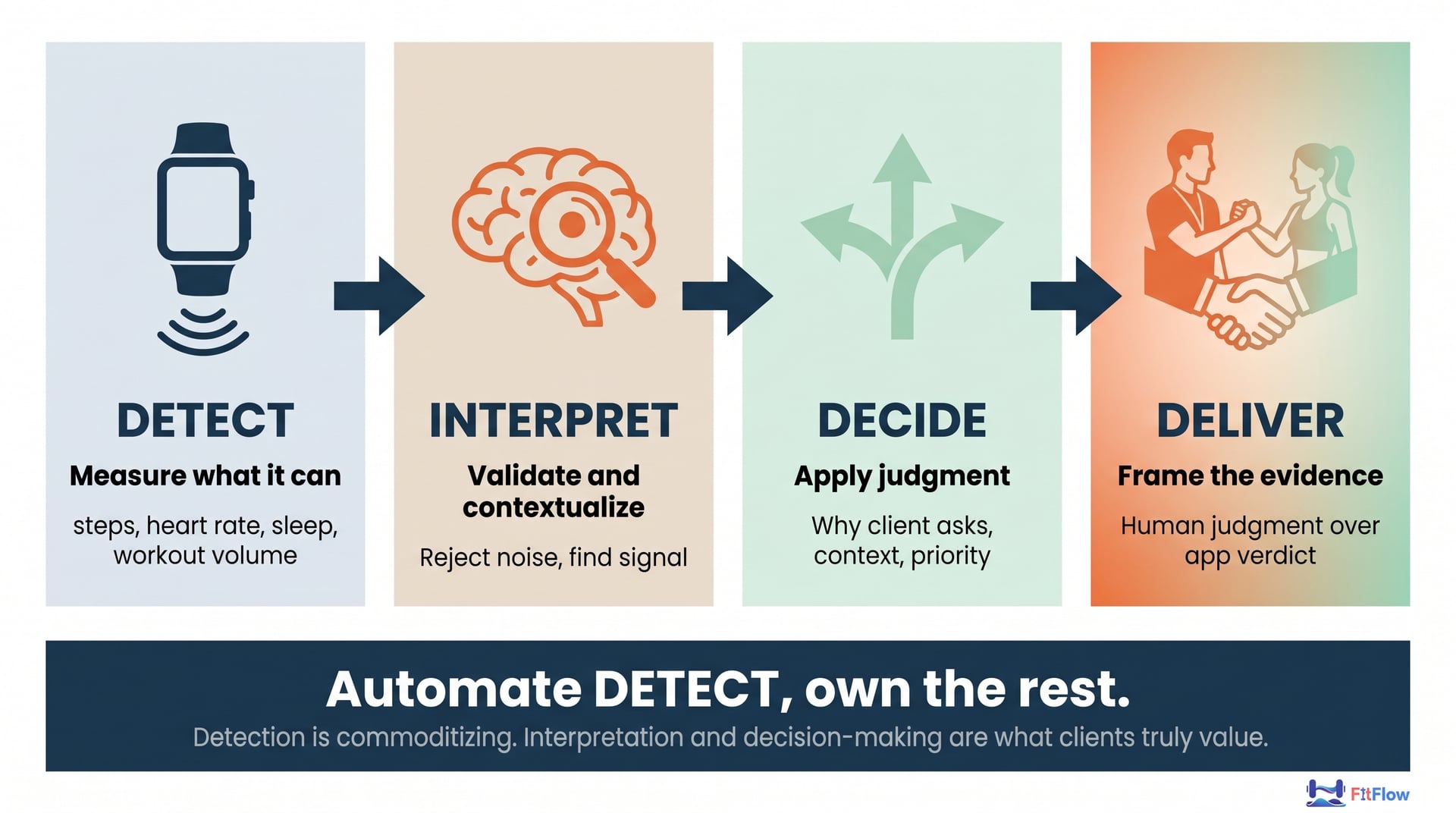
Wearable data flows through four layers. Most coaches collapse these layers into one ("the app said, so it's true"). Separating them is where you reclaim authority.
DETECT (What the App Does)
Detection is commoditizing. Wearables measure what they're designed to measure—steps, heart rate, estimated sleep duration, workout duration—with 90–95% accuracy in their specialized domain. Detection is an engineering problem. Apps solve it well.
Your job: accept that DETECT happens, but don't let it drive decisions.
INTERPRET (What the Coach Does)
This is where you live. Interpretation means:
Validating the measurement. Does this person's HRV typically sit around 50ms? If yes, a reading of 44ms isn't alarming—it's noise. If their HRV typically ranges 65–75ms and drops to 45ms, that's signal. You need a baseline. The app doesn't build baselines; you do.
Contextualizing. A client hit 8,000 steps today. The app doesn't know why. Was it a work commute (irrelevant to training status) or a bonus walking session (relevant)? You know the context. The app doesn't.
Rejecting false signals. Your client slept 6:15 but feels great and hit all their lifting RPE targets. The sleep score of 62 is noise. You have permission to ignore it. Lived experience trumps algorithm.
Interpretation requires knowledge of the client—their typical patterns, their context, their goals. It's not data literacy. It's coaching. (See our framework for evidence-based coaching decisions for more on this layer.)
DECIDE (Coaching Judgment)
You see the data. You interpret it. Now you decide whether it changes your coaching plan.
This is the hard part because it requires you to:
Prioritize why the client is asking. A client brings you their HRV drop and wants to know if they should ease up. But is that coming from genuine fatigue concern or anxiety about "doing it wrong"? The answer shapes your response. The data doesn't answer it.
Use data as input, not verdict. "Your step count is low and you're reporting fatigue and we have a meet in three weeks and your sleep has been inconsistent—so we're deloading." That's decision-making. Saying "your readiness score is 48, so you're resting" is abdication.
Create a hierarchy of evidence. Lived experience ranks higher than algorithms. Client report ranks higher than device measurement. Trends rank higher than single data points. Your coaching experience ranks higher than proprietary formulas. Most coaches invert this hierarchy.
DELIVER (The Coaching Relationship)
How you communicate about data determines whether clients become independent or dependent on apps.
Frame data as evidence, not truth. "Your watch shows your recovery is slower this month. That aligns with what I'm seeing in your training—let's build in an extra rest day." vs. "Your watch says rest, so we're resting." The first educates. The second outsources your authority.
Never let app overrule lived experience. "Your watch says go hard; your knee says no. We're listening to your knee." This permission is everything. It signals that you trust your client's body more than the algorithm.
Translate data back to human scale. Most clients don't understand what HRV, training load, or readiness scores actually mean. Explain: "Your HRV dropped 8 points—that's normal variation and doesn't change your plan." or "This score is based on an algorithm trained on thousands of people, not on you specifically."
The Moat Line
Here's the competitive advantage: Automate DETECT, own the rest. Detection is commoditizing; interpretation and decision-making are exactly what clients pay to keep.
Every wearable company on Earth can build better sensors and algorithms. They can't build the coach-client relationship. They can't know your client's context. They can't make judgment calls that balance data with wisdom.
This is why coaches who master interpretation will thrive. Coaches who outsource their judgment to app algorithms will lose clients to better coaches.
The framework, as something you can actually run on Monday. DETECT → INTERPRET → DECIDE → DELIVER is the argument. The checklist is the procedure: name what the sensor is doing, grade the validation, run it against what your client actually reports, and route the answer to one of three calls — investigate, ignore, or explore further — each with the exact questions to ask. Get the Wearable Data Decision Checklist.
Three Types of Data Clients Can Give You That Apps Never Will
Here's the leverage point: you have a tool wearables will never match—your client's honest voice.
Subjective Readiness/Fatigue (Daily 1–10 Scale)
"How do you feel today, 1–10?" is a better predictor of performance than any wearable's readiness score. And it's free.
Peer-reviewed research confirms it. Perceived exertion and subjective fatigue rank as coaches' second-most-used readiness indicators (after HR data alone). The reason: clients are honest about how they feel. Apps guess about what the numbers mean.
This doesn't require technology. A Slack message, a Google Form response, a text message. Something simple and consistent. A client reporting "6/10 today, lower back's been tight" gives you actionable information. (For a deeper dive on building subjective readiness into your coaching system, see our guide to RPE and perceived exertion.)
Lifestyle Context (Weekly or As-Needed)
Apps measure sleep duration. They don't measure sleep quality. Don't ask your client "how many hours?" Ask "did you wake up? Racing thoughts? Feel rested?"
Stress source matters too. "My stress level is high" is vague. "Work deadline burning me out" is specific and actionable. That context helps you decide whether to back off intensity or lean in (sometimes stress is best managed through controlled training).
Nutrition adherence, injury flags, life changes—all client-reported, all more reliable than wearable proxies. Clients know their reality. Devices guess at it.
Performance Subjectives (During and Post-Workout)
"How did this lift feel?" is more predictive of injury risk than training load metrics. When a client says, "This squat felt heavier at the same weight," they're signaling neural fatigue or form regression. The app doesn't see that.
Perceived exertion (RPE) is more valid for zone training than heart rate zones derived from formulas. Motivation level matters: "I didn't want to be here today" changes how you interpret the session.
These data types are client-generated, honest, and trainable. They give you meaning, not just measurement. Wearables give you numbers. Clients give you context.
For Gym Owners: Evaluating New Wearable & Software Partnerships
If you're evaluating a new wearable platform, integration, or readiness tool for your gym, here's how to avoid the trap.
Ask what the tool is not measuring:
Tool Claim | What It Actually Measures | Validation? | Liability If Wrong? | Better Alternative? |
|---|---|---|---|---|
"AI-powered readiness" | Proprietary algorithm on HR + sleep + HRV | No peer review | Full coach liability | Ask client directly; track 30-day HR trend |
"Clinical-grade HRV" | Wrist optical sensor | Yes; ±10ms of gold standard | Partial (injury risk) | Require chest strap for training decisions |
"Blood glucose integration" (Apple Watch) | Estimated from optical sensor (not FDA-cleared) | Limited | FULL liability (not diagnostic) | Don't use for nutrition decisions |
"Sleep stage accuracy" | Actigraphy + HR (not polysomnography) | Yes; ~60–75% accurate | None (informational only) | Use trend only; never diagnose |
"Calorie burn" | HR-estimated energy (not true expenditure) | Yes; ±15–55% error | None (informational only) | Don't use for nutrition math |
Before buying, ask:
"What is this tool not measuring, and why?" (Transparency separates good vendors from bad.)
"If this tool flags someone unsafe and injury occurs, whose insurance covers it?" (Liability clarity matters.)
"Can coaches see why the tool made that call, or just the number?" (Black boxes shouldn't drive decisions.)
"Does this tool make my clients dependent on it, or independent?" (Coaching goal is independence.)
"Is this algorithm trained on peer-reviewed research or proprietary data?" (Validated > proprietary.)
Red flags:
"AI-powered readiness" without peer-reviewed validation
"Medical-grade accuracy" (if truly medical, it needs FDA clearance—most wearables aren't cleared)
Retention gamification baked into client UX (streaks, algorithmic readiness boosts)
Platform lock-in (can coaches export data, or are they hostage to the vendor?)
Most platforms fail at least two of these tests. That's the signal that they're built to lock in clients, not to serve coaching.
Data Doesn't Replace Coaching. It Serves It.
Here's where to lean on wearable data:
Adherence motivation. If your client loves tracking steps or closing rings, let them love it. The psychological value is real. (For more on behavior change and habit systems, see our guide to habit tracking and adherence.)
Relative trend spotting. Direction matters; absolute numbers don't. A 30-day resting HR trend is valid. A single day's readiness score isn't.
Objective workout logging. If honestly logged, wearables create consistency.
Training load progression. Garmin Training Stress Score (TSS) or TrainingPeaks Intensity Factor (IF) over 4+ weeks surfaces real adaptation.
Here's when to ignore it:
Absolute numbers divorced from lived experience. If the data says rest but your client feels strong and performed well, the data is wrong for that client.
Readiness scores or magic algorithms. These are confidence illusions. Ask how the client feels instead.
Calorie burns justifying eating more. This almost never ends well.
Anything contradicting how the client actually feels/performs. Experience beats algorithm. Always.
The final permission: Using wearable data well is a skill—spotting real signal vs. noise vs. deliberately hidden information. That's exactly what clients pay you for.
Wearable companies want to own the coaching decision. Your job is to translate data back to human, then decide together with your client. Coaches who master this interpretation layer will thrive. Coaches who outsource judgment to app algorithms will watch better coaches win their clients' trust.
Data is a tool. It serves coaching. It doesn't replace it. And the coaches who understand that difference will own the next decade of professional coaching.
Keep the part you'll actually use. You don't need apps to be perfect to use them well. You need to know what the app measures, whether it matches the person in front of you, and what you're going to do about it. That's the whole checklist — five steps, three validation levels, three coaching decisions, and the five red flags that end the inquiry before it starts. Download the Wearable Data Decision Checklist.
Frequently Asked Questions
Comments