
When to Stop Tracking Macros: A Coach's Exit Framework

A coach sent me a screenshot in March: eleven weeks of a client's food log, and from week five onward the same seven meals repeat in the same order, weekends included, protein landing within four grams of target every day.
He wasn't asking whether the data was any good. He knew. He was asking what I now get asked more than any other nutrition question: when to stop tracking macros, and how you're supposed to know it's time.
Start in 1992, because the number everyone throws around comes from there. Researchers screened 224 consecutive patients presenting for obesity treatment and studied the subgroup who insisted they were eating under 1,200 calories a day and still not losing weight. Doubly-labelled water settled it. That subgroup — deliberately selected because their reports didn't match their outcomes, which is exactly why the figure is not a population average — underreported actual intake by an average of 47±16 percent (Lichtman et al., New England Journal of Medicine, 1992).
That figure is usually deployed as a weapon by someone arguing tracking is pointless. This isn't that argument. The error is real and it does not make tracking worthless — it means tracking was never the measurement your client thinks it is. Someone logging 1,847 calories believes they've measured something to four significant figures; they've produced a wide-banded estimate, at real cost. That gap, between the precision the client feels and the precision the method delivers, is where tracking fatigue is born.
Which changes the coaching question. It is never is my client tracking accurately enough? It is is my client still learning anything from the estimate? Macro tracking is a diagnostic instrument, not an operating system: validly precise for a bounded window, decaying in accuracy and psychological cost the longer it runs. Your job is to know the exit criteria and what replaces it.
The line this piece hangs on: prescribe the exit when you prescribe the tracking.
Decide Who Comes Off Tracking This Week — and What Replaces the Number. The free Tracking Exit Checklist turns everything below into a pass you can run against a whole roster in one sitting. Six sections, 50 items: the four-mode diagnostic, the four-question mandate you complete at prescription time, the five-rung step-down, verbatim check-in scripts, the replacement menu, and the referral triggers with the sentence to say. Open it now and diagnose one client as you read. Get the Free Checklist.
Tracking works. That's what makes this hard.
Two camps own this topic, both more certain than the evidence licenses.
Camp one tracks forever. Precision as identity: the app's number is ground truth, adherence failure is the client's character problem, measurement error never modelled. What that camp gets right isn't small — tracking genuinely works while it's being done. Across two mHealth randomised weight-loss trials, the days a participant logged at least two eating occasions explained more variance in six-month weight loss than any other adherence definition tested (R²=0.27, P<0.001; Turner-McGrievy et al., 2019).
And in the same paper, on every adherence definition examined, fewer than half the sample was still tracking after week 10. Never quote either finding without the other. Tracking works and tracking decays, and the decay is the default trajectory, not a defect in your roster.
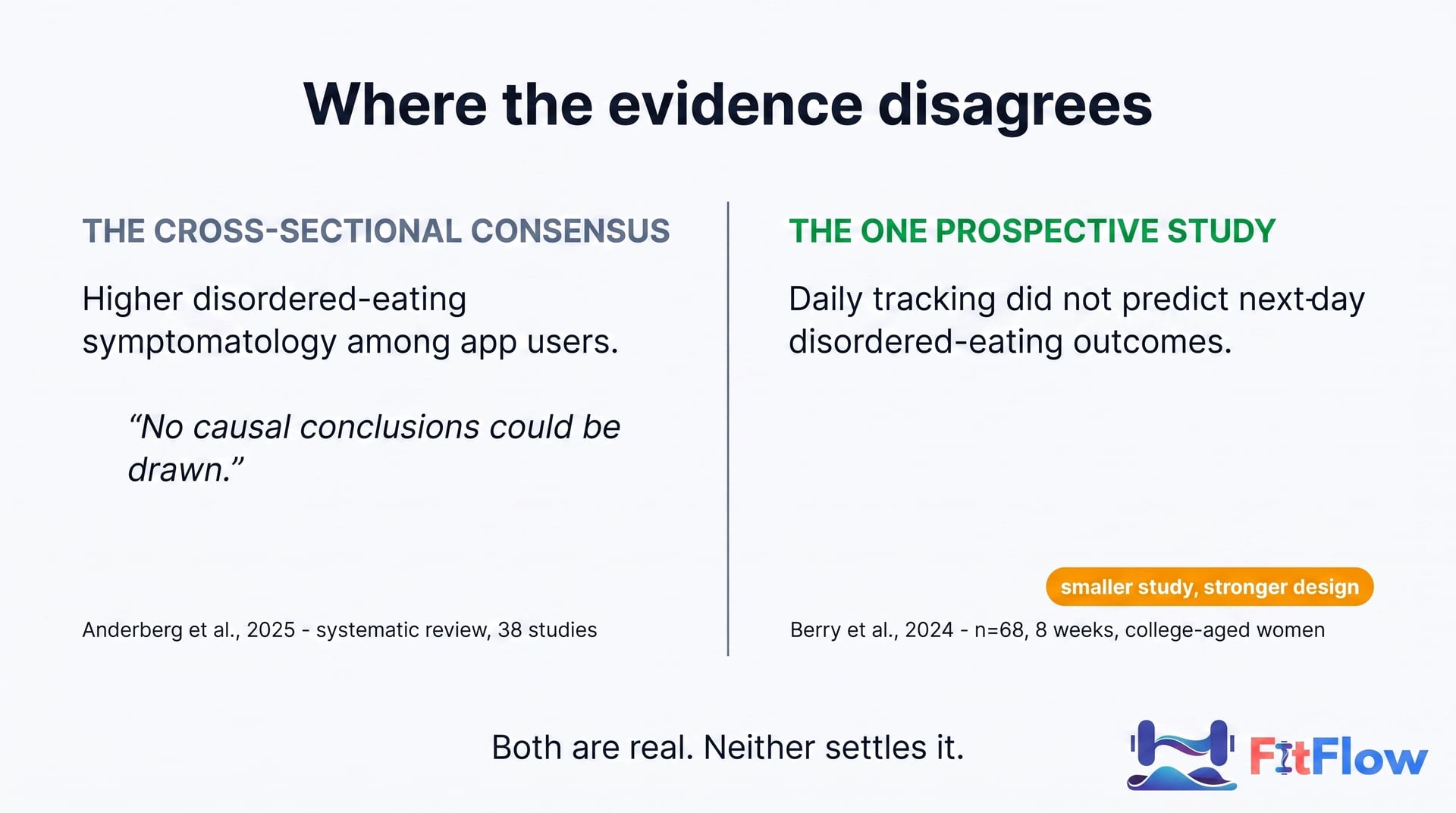
Camp two never tracks. Right about the cost, wrong to throw away the instrument. It correctly identifies that logging carries an under-discussed psychological load — then discards the one tool that reliably surfaces a real intake gap in the first four to eight weeks, usually on a causal claim the literature doesn't support. A 2025 systematic review of 38 studies found disordered-eating symptomatology higher among diet and fitness app users and stated plainly: "No causal conclusions could be drawn" (Anderberg, Kemps & Prichard, Body Image, 2025).
Neither camp is the villain; both are solving something real, badly. The centre: tracking earns its place by what it teaches. When the teaching curve flattens, the instrument becomes a tax — your client keeps paying the attention cost and stops receiving information. Not a failure of will: an instrument that finished its job and never got put away.
If you're not sure the tracking is the problem, start upstream with the adherence-decay diagnostic. This is what to do when the failing thing is the measurement. It sits under the nutrition and recovery guide, and we've run the false-precision argument elsewhere — protein timing fails the same way.
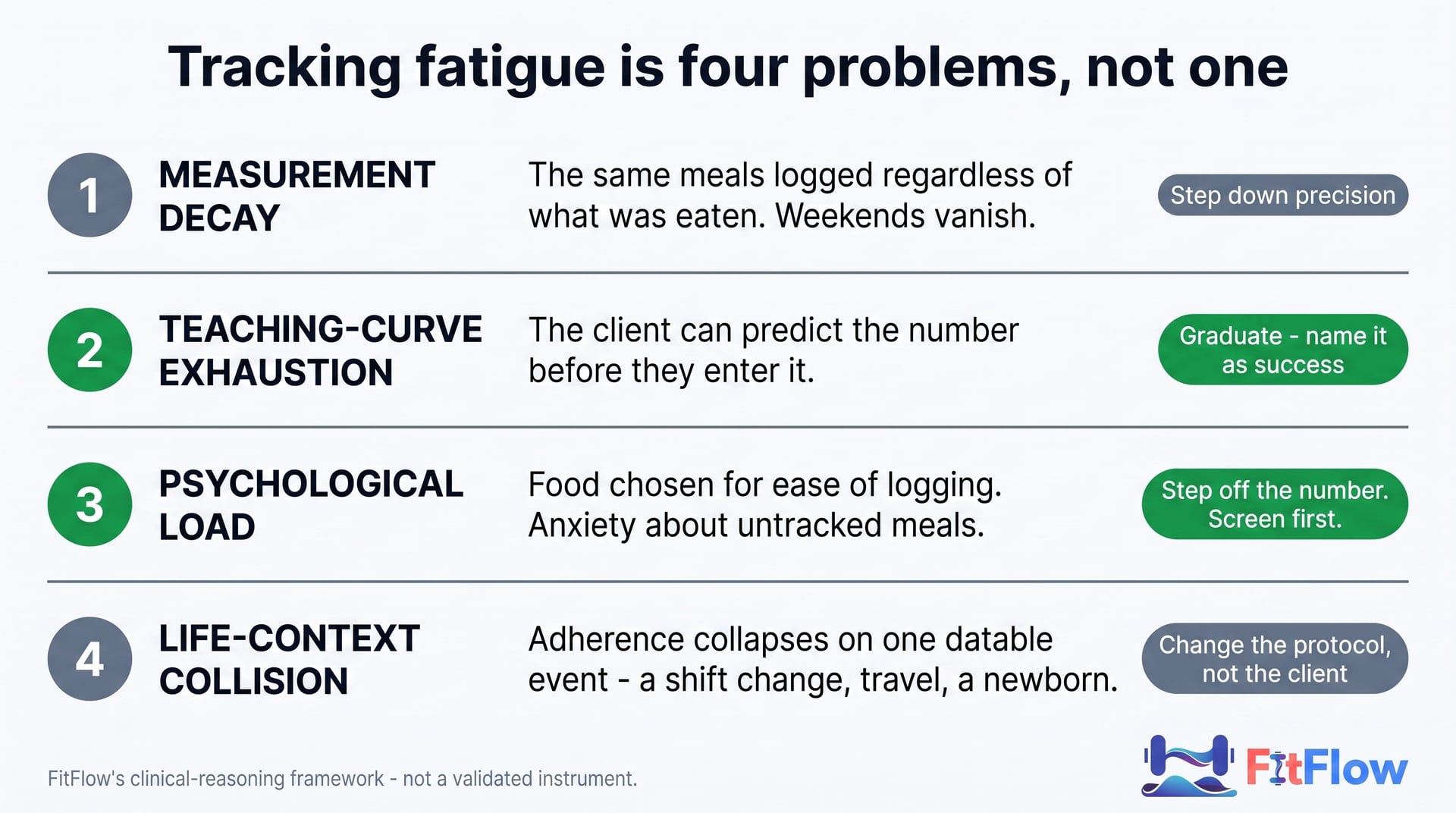
Tracking fatigue is four problems, not one
Every competing page treats fatigue as one condition: the client got tired, and is either ready to stop or needs to push through. That's a motivation frame, and the motivation frame is the error. Tracking fatigue is four failure modes wearing the same expression, each with a different off-ramp, and treating all four as needs more discipline is how you lose a client you could have kept.
# | Failure mode | What it looks like | What it actually is | Off-ramp |
|---|---|---|---|---|
1 | Measurement decay | The same seven meals regardless of what was eaten; weekends vanish; portions stop changing | Logging still happens. The data stopped being true | Reduce precision deliberately so the record becomes honest — an accurate estimate beats a fictional measurement |
2 | Teaching-curve exhaustion | Logging is accurate, consistent, and the client predicts the number before entering it | The instrument finished teaching. More logging adds cost, no information | Graduate them. This is success, and should be named as success out loud |
3 | Psychological load | Food chosen for loggability; anxiety about untracked meals; distress at social eating; shame around the number | The tool is driving the behaviour, not measuring it | Step off the number entirely and onto structure. Screen the red-flag line first |
4 | Life-context collision | Adherence collapses on a datable boundary — a shift pattern, travel, a sick parent, a newborn | The protocol became impossible. The client didn't change | Change the protocol, not the client. Lowest-burden method that still surfaces the variable that matters |
Mode 1 has a number attached: a 2026 scoping review of 68 studies across 46 calorie-counting apps reports self-monitoring with MyFitnessPal decreasing from 5.4 to 1.4 days per week from weeks 4 to 12 — a scoping-review synthesis rather than a single trial, describing that window and no further (Dugas et al., JMIR mHealth and uHealth, 2026). A client logging most days is, two months later, logging twice a week and still calls it tracking.
Two misreadings account for most of the damage.
Modes 1 and 4 get misread as mode 3. The coach sees non-compliance, reaches for a careful conversation about the client's relationship with food, and the actual problem was a night-shift rotation that started on 14 April. That conversation is not neutral: you've just told someone whose life got harder that their psychology is the issue. Mode 4 looks most like a character problem and is least likely to be one — stopping in week 7 is the statistically normal thing.
Mode 2 gets misread as mode 1. Logging looks sloppy, so the coach tightens. But the client stopped varying entries because they already know what their food weighs: they finished learning, signalled it, and got more homework. The most avoidable cancellation there is.
You Know Which Clients Have Stopped Logging Properly. You Don't Know Which Ones to Take Off It. Holding the line on a client who has finished learning costs you the client. Letting go of one whose data just got sloppy costs you the result. They look identical in a check-in — "yeah, still tracking, it's fine" — and they need opposite interventions. Section 1 of the free checklist is this diagnostic as a one-minute pass: what you observe in the log against what you hear in a check-in, and the verdict each one routes to. Tell Them Apart.
One honesty requirement — the four-mode taxonomy is FitFlow's clinical-reasoning framework, not a validated instrument. No study has tested it. Two adjacent arguments one click away: keeping the wrong metric, and diets that fail by design — rule both out before concluding a client isn't progressing.
The four-question tracking mandate
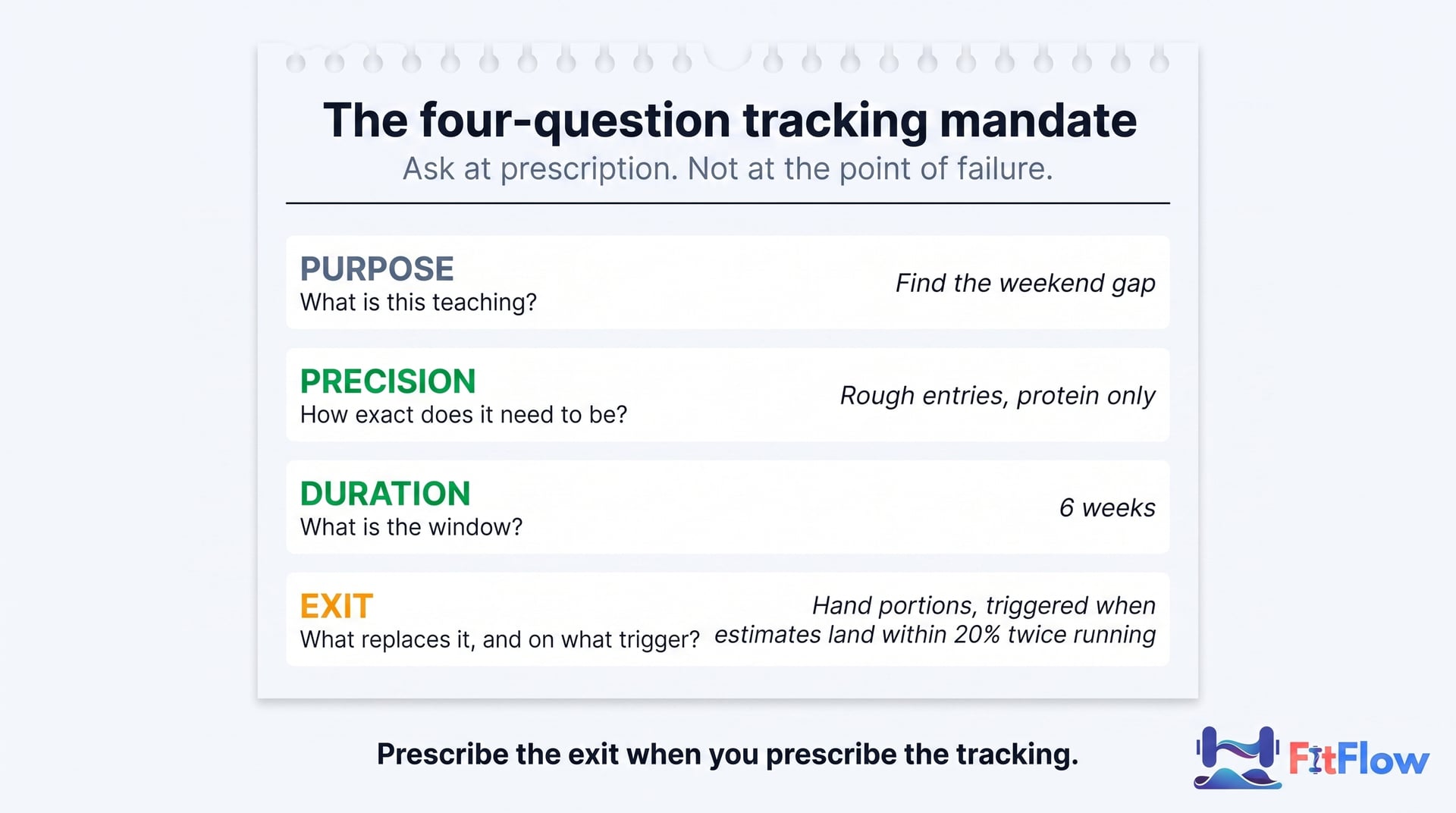
Here's the move that separates a plan from a rescue: ask these four questions at prescription, not at failure. Asked when a client is already fatigued, the exit arrives as damage control, the client half-convinced they've failed. Asked on day one, it's a scheduled event.
Question | What it settles | The failure when you skip it |
|---|---|---|
Purpose — what is this teaching? | The thing this client doesn't yet know: portion reality, the protein floor, the weekend gap, the link between intake and the scale | Tracking becomes a loyalty ritual with no endpoint. You cannot exit a protocol whose goal was never stated |
Precision — how exact must it be? | Grams, rough entries, protein-only, or a photo log. Most goals don't need the top of that range | Every client gets maximum precision by default, maximising burden and buying nothing |
Duration — what is the window? | A number of weeks, set in advance and said out loud. The useful window runs in weeks, not quarters — logging roughly quarters between weeks 4 and 12 (Dugas et al., 2026, a scoping-review synthesis) | Open-ended tracking, the largest single generator of mode-2 and mode-3 fatigue |
Exit — what replaces it, on what trigger? | The named successor method, and the observable condition that starts the handover | Quitting becomes something your client does in secret, and you find out weeks later |
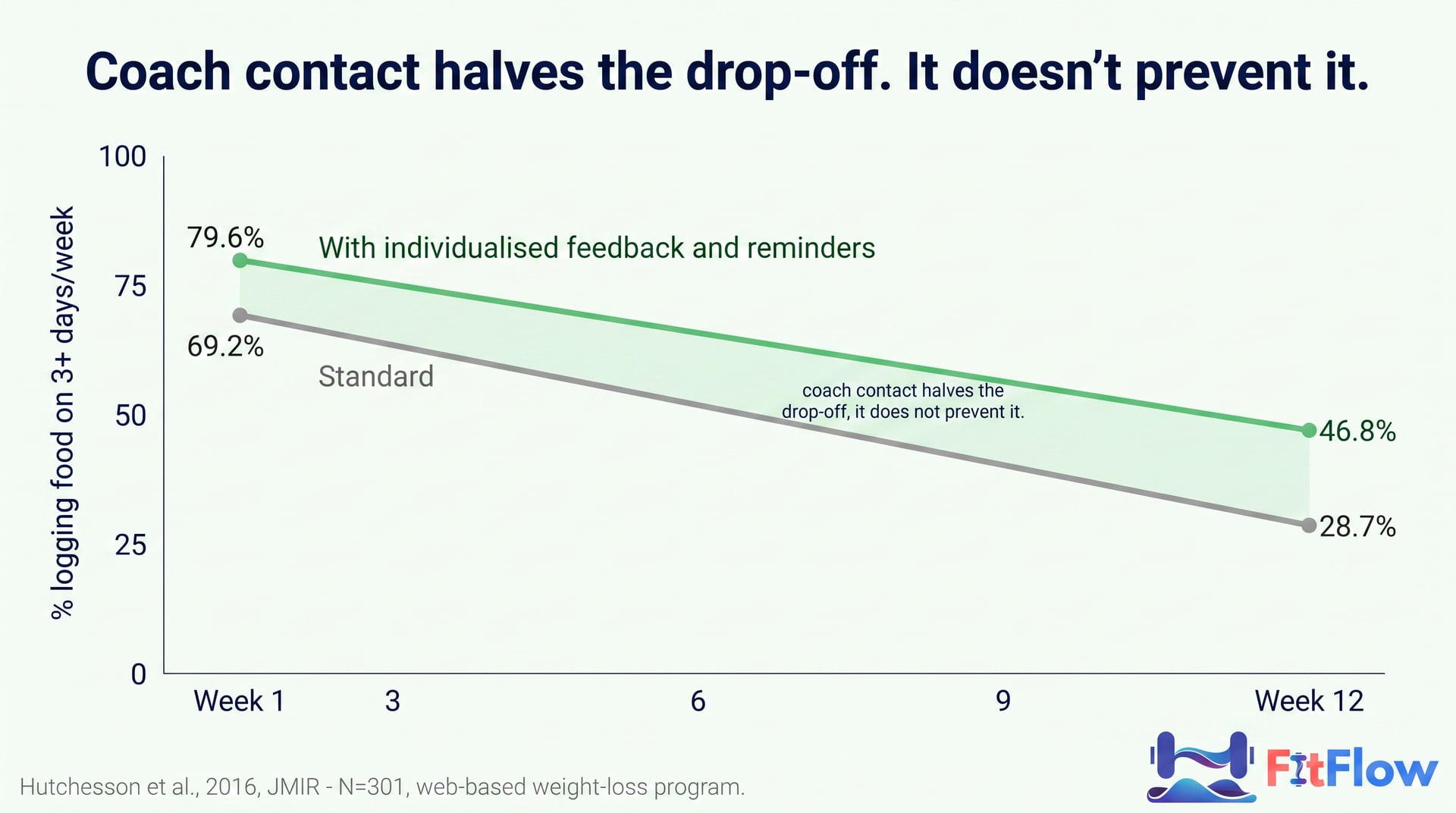
Duration is the one coaches skip and the one doing the most work — the overlooked variable usually is. An open-ended protocol has no success condition, so it can only end in exhaustion. Set the window against the curve you'll get. In a 301-participant web-based programme, food entries on three or more days a week fell from 69.2% in week 1 to 28.7% by week 12 in the standard arm — and from 79.6% to 46.8% in the arm receiving extra individualised feedback and reminders (Hutchesson et al., Journal of Medical Internet Research, 2016). Read that second arm carefully: coach contact roughly halves the drop-off and does not prevent it. A protocol depending on out-accountabilitying the curve is already failing on paper — usually in the month-three window where retention decisions get made.
A check-in template with no field for each is a structural gap worth closing — the check-in structure that makes it visible.
The 5-step de-escalation ladder
Step 1 decides what the rest of the ladder is allowed to do.
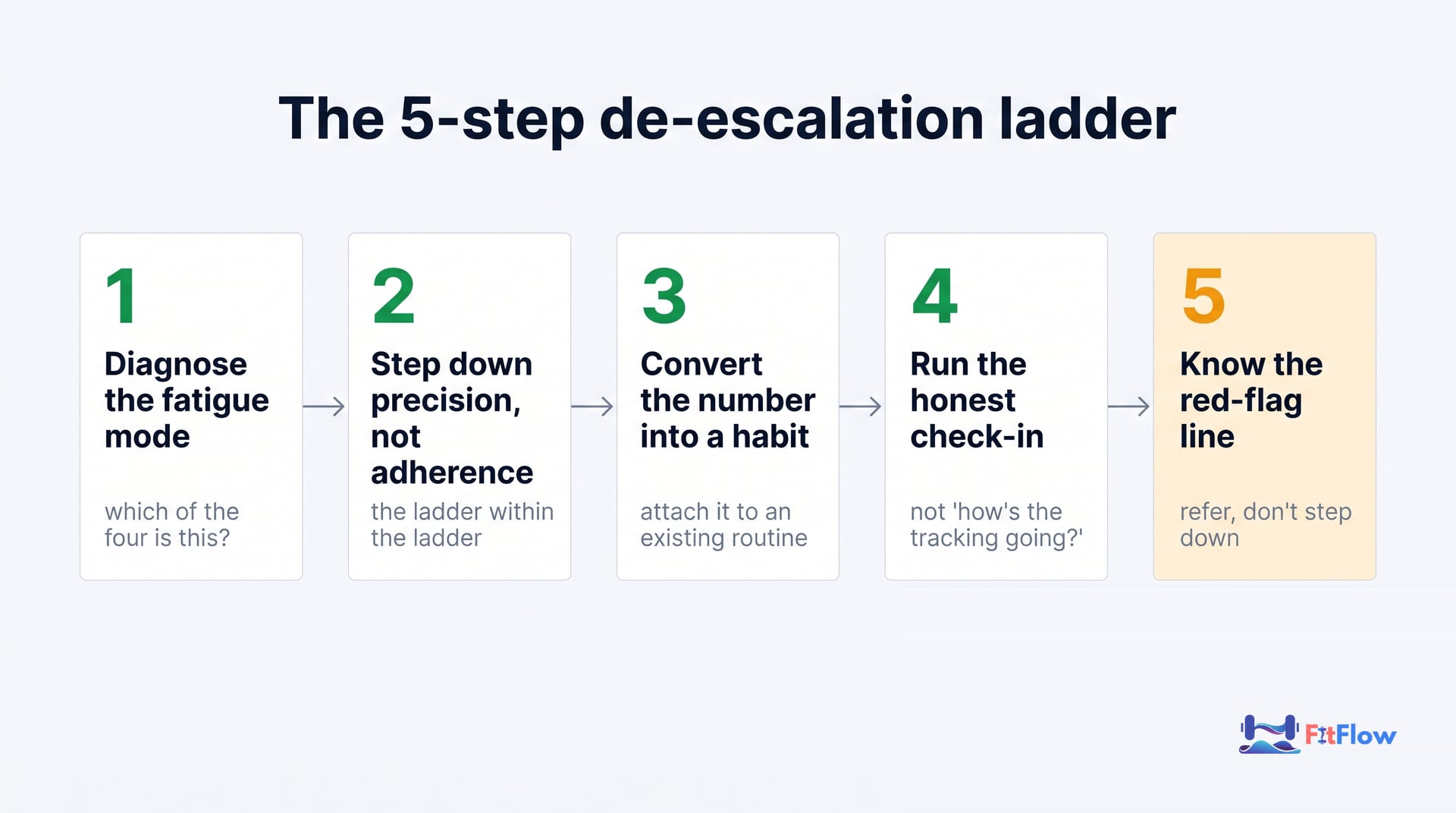
Step 1 — Diagnose which of the four modes you're looking at
Three questions sort most of it, before you change anything:
When did it change, and can the client name a date? A datable boundary points hard at mode 4.
Is the logging still accurate? Entries that stopped varying while meals didn't is mode 1.
Can the client predict the number before opening the app? If yes, mode 2 — a pass, not a fail.
The question separating mode 3 from the others is different in kind and sits in the conversation section below, because how you ask determines whether you get an answer. Mode 3 changes what you're permitted to do next, so settle it first.
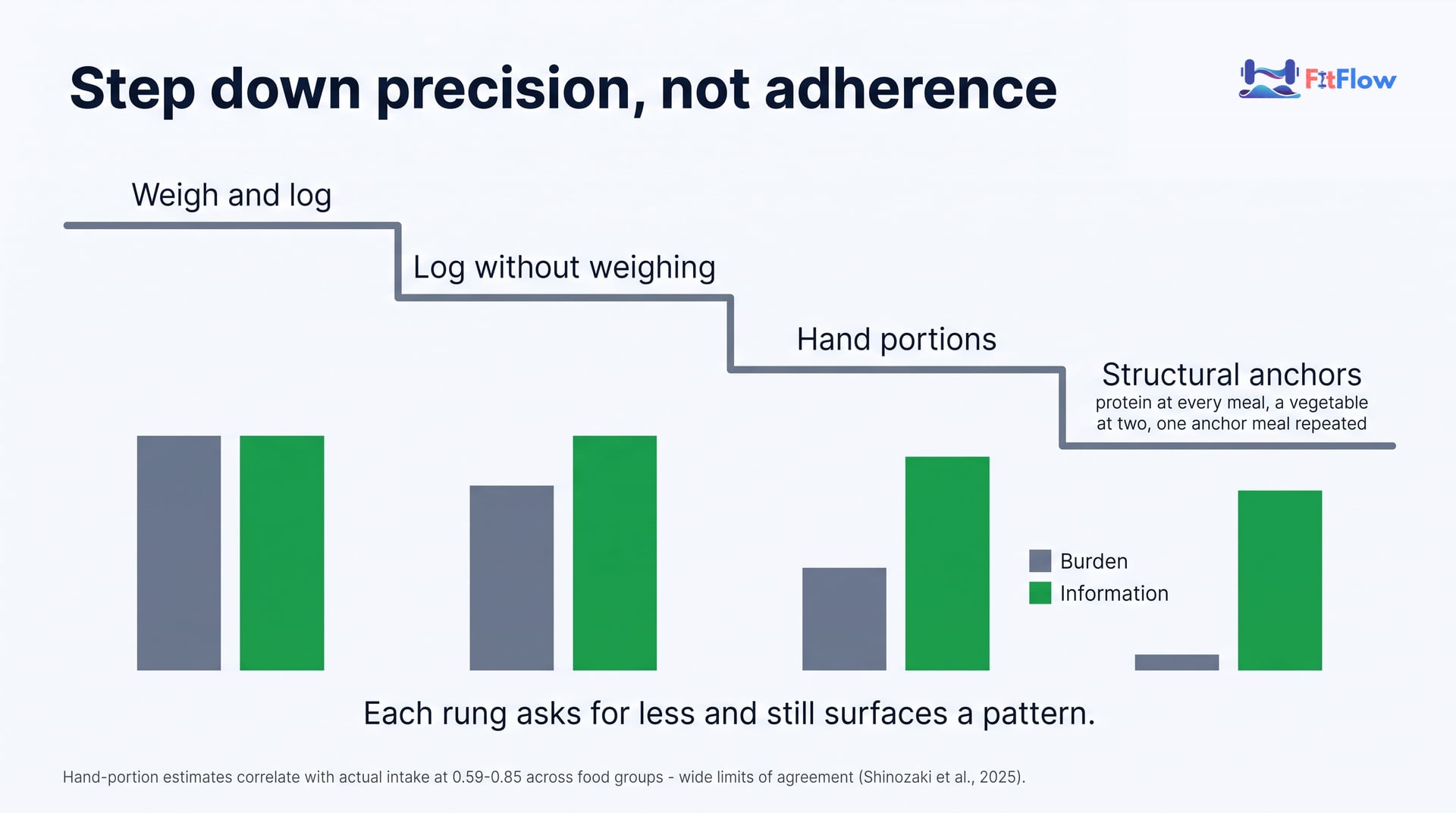
Step 2 — Step down precision, not adherence
There is a ladder inside the ladder — weigh and log, then log without weighing, then hand portions, then structural anchors (protein at every meal, a vegetable at two, one repeated anchor meal). Each rung asks less and still surfaces a pattern, and the evidence permits it. Across 1,081 free-living adults and 12,148 weighed-record meals, self-reported hand counts correlated with actual consumption at 0.72 for protein foods, 0.76 for vegetables, 0.85 for fruit and 0.59 for grains — and the authors' own qualifier belongs in the sentence, "despite wide limits of agreement" (Shinozaki et al., Appetite, 2025).
Hand portions are adequate. They are not equivalent. Say so to your client — the honesty is what makes the rest of the ladder credible. For the mechanics, the nutrition-frameworks post installs the structure properly.
The reframe: you are not lowering the standard, you are lowering the precision so the standard becomes achievable. An honest estimate four days a week beats a fiction seven days a week. Same trade you already make moving to RPE, and nobody calls autoregulation the soft option.
Step 3 — Convert the number into a habit the client already performs
Attach the successor behaviour to a routine that already exists: protein at the meal they eat at the same time daily. Then set the timescale honestly. In the closest real-world study, automaticity took a median of 66 days, range 18 to 254 (Lally et al., European Journal of Social Psychology, 2010). The range is the point — a client who hasn't internalised a habit at eight weeks is inside the normal distribution. The same study found missing an occasional repetition did not materially impair formation, which licenses a sentence in the next section.
Step 4 — Run the check-in that gets an honest answer about the tracking itself
"How's the tracking going?" has one socially available answer. Scripts below.
Step 5 — Know the red-flag line where the answer is "stop and refer"
Mode 3 has a floor. Below it your job stops being nutrition coaching and becomes routing.
The conversation layer: what to actually say
Every competing page ends at "have an honest conversation" and supplies none. Here are the sentences.
One thing first. When researchers collected 58,881 posts about the five most profitable fitness apps and filtered them for negative sentiment down to 13,799 — a filter that makes the sample evidence of what people complain about and never of how many do — the recurring content was shame, guilt, notification irritation and target rigidity (Sheen et al., British Journal of Health Psychology, 2025). A check-in assuming a discipline problem lands on top of all four.
To surface mode 3 without leading the client, and without playing clinician:
"Separate question from how the numbers are going. When you eat something you haven't logged — you're out, someone hands you a plate — what happens in your head for the next hour?"
It asks about a situation rather than a feeling, so it hands your client no diagnosis to agree with. "Nothing, I log it later" is one world; "I think about it all evening" is another world.
To separate "logging has gone sloppy" from "logging has finished its job":
"Try this before your next three dinners. Guess the calories and the protein, write the guess down, then log it and compare. Send me all three."
A test your client runs on themselves, turning the exit decision into evidence. Close guesses confirm mode 2; wildly off while the logging looked immaculate is mode 1.
To name the exit as a graduation rather than a concession:
"You've been doing this eleven weeks and you can call your protein within ten grams without the app. That's the skill. The app was the training wheels for the skill. We're taking them off because it worked, not because we're giving up on it."
A client not told why the tracking stopped supplies their own reason, usually that you lost faith.
To give permission to a client who quietly stopped weeks ago:
"I noticed the logging tailed off around the start of last month. That's completely normal — in the trials, more than half of people have stopped by week ten. I'd rather build around what you're actually doing than around what the app says. What did the last few weeks really look like?"
Keep it small: name it, normalise it with the number, move on. Making the disclosure a big event teaches your client that honesty is expensive. And since missing repetitions doesn't wreck habit formation, a missed day isn't a relapse.
To say the referral sentence:
"Some of what you've described sits outside what I'm qualified to work on — that's a scope thing on my side, not a judgement about you. I'd like to put you in touch with a dietitian who works in this area. I'm not stepping back from your training. I'd like us both working on it."
Say it plainly, without dropping your voice — euphemism reads as alarm.
The GLP-1 exception
The clean arc of this piece is teach, step down, exit. Clients on GLP-1 medication break it, and it's more useful to say so than pretend otherwise.
When appetite collapses pharmacologically, intake can drop below the floor without your client noticing, and the risk inverts from over-eating to under-fuelling and lean-mass loss. Lean soft tissue accounted for 26–40% of total weight loss in recent GLP-1 and GLP-1/GIP receptor agonist trials (Tinsley & Nadolsky, SAGE Open Medical Case Reports, 2025). In the same paper — a case series of three patients, so treat the individual numbers as illustrations and not as expected results — one patient lost 6.9% of lean mass while two gained it, all three on resistance training three to five days a week with protein at the high end.
So some monitoring may still be warranted here, precisely when the appetite signal intuitive replacements rely on is unavailable. The resolution isn't "keep tracking everything" but a narrowed instrument: track the protein floor and resistance-training frequency, drop the rest — Purpose and Precision applied where the purpose changed mid-protocol. The full treatment is in the GLP-1 coaching guide, and the recovery markers you already watch do double duty on these clients.
Where the evidence is thin — and what that means for your client
This is not a hedge paragraph before the conclusion. Reading the evidence honestly is the professional skill here.
What we don't know is the direction of the arrow. Whether tracking causes psychological harm, or whether people already carrying eating concerns select into it, is unresolved. Anderberg and colleagues reviewed 38 studies and said it outright: no causal conclusions could be drawn. Nearly the entire literature is cross-sectional, and that design cannot separate the two directions however often the association replicates — and it does replicate, most cleanly among 493 college students whose tracker use accompanied higher eating concern and dietary restraint, hedged by the authors as "preliminary" (Simpson & Mazzeo, 2017).
The one prospective study points the other way, and it is small. Berry and colleagues followed 68 college-aged women using MyFitnessPal for eight weeks with repeated daily measures. Tracking frequency was associated with weight and shape concerns at the trait level, but daily tracking did not predict next-day disordered-eating outcomes on any measure, and within-day tracking was associated with lower dietary restraint at the next timepoint. The authors: "over time fitness tracking was not associated with an increase in concerns" (Berry et al., International Journal of Eating Disorders, 2024).
Then the honest thing, which neither camp will say. n=68, eight weeks, one population — college-aged women in one country. The best-designed study available is also one of the smallest, and it disagrees with the cross-sectional consensus. That is an unsettled question.
Individual variation exceeds the group effect almost everywhere here. A 66-day habit median against a range of 18 to 254. A ±16% standard deviation on an under-reporting figure already from a selected subgroup. Hand-portion correlations running 0.59 to 0.85 by food group, with wide limits of agreement inside every one. Every group-level number here predicts a population, not a person — the same problem wearable data has.
And "the study says X" does not overrule your client. A client who tells you tracking is making them miserable is reporting a fact about themselves, and Berry et al. gets no vote on it. That null result describes 68 people over eight weeks and says nothing about the person in front of you; a coach who uses it to talk a client out of their own experience has done the precise harm this post exists to prevent. Take the report at face value, every time.
And the four-mode framework is untested. A reasoning aid, not an instrument. Use it because it organises a decision well, not because it's validated. It isn't.
Your referral line
Refer out — do not step down, do not renegotiate, refer — when any of these is present:
Distress, secrecy or compulsion around logging, or an inability to eat without logging
Food choices driven by loggability rather than preference or hunger
Purging, laxative use, compensatory exercise, or fasting to make the numbers work
Amenorrhea, or the low-energy-availability signs described in the IOC's 2023 consensus statement on Relative Energy Deficiency in Sport (Mountjoy et al., British Journal of Sports Medicine, 2023)
Rapid unintentional weight loss, or a client who has quietly stopped eating enough to hit the target
A client disclosing a current or past eating disorder
Energy availability is the hard boundary in both directions. It's where nutrition coaching stops and clinical care starts, and the one thing you must recognise without diagnosing.
The scope statement, plainly: recognising a signal and routing your client to a dietitian, physician or eating-disorder specialist is inside a trainer's scope. Screening, diagnosing, interpreting a clinical assessment tool, or treating is not. The IOC's Clinical Assessment Tool v2 is named in that consensus statement; it is a clinical instrument, and knowing it exists while someone else administers it is the whole of your job here — the same scope pattern that governs programming decisions for female clients: recognise, route, stay in the room for the training.
One last thing, about you rather than your client. A 2025 systematic review found high levels of disordered eating among fitness professionals, personal trainers higher than the rest — nine studies, inconsistent assessment instruments, small samples, no prevalence figure available to quote (Carroll, Newman, Cradock, Bruha & Sharpe, Eating Behaviors, 2025). The practice point is narrow: a coach for whom daily logging feels normal is the one most likely to under-read psychological load in a client, because the client's experience doesn't match their own and reads as a discipline gap. That's the argument for writing the exit criteria down rather than leaving them to judgement.
Prescribe the exit when you prescribe the tracking
The coach with the screenshot had a mode-2 client: eleven weeks of accurate logging, entries that stopped varying because she already knew what her food weighed. He'd read it as sloppiness and was about to tighten. He ran the guess-then-log test instead, she came within eleven grams on all three dinners, and they graduated her — and he said so out loud.
The short version:
Tracking works and tracking decays. Both from one study. Plan for the curve you'll get.
Fatigue is four problems. Diagnose before you adjust — mode 4 looks like character and almost never is.
Ask the four questions at prescription. Purpose, precision, duration, exit — duration is the one you skip.
Step down precision, not adherence. An honest estimate four days a week beats a fiction seven.
Know the red-flag line and say the referral sentence out loud. Euphemism there is a safety failure.
The evidence is unsettled; your client's report isn't. Never use the first against the second.
None of this requires you to stop prescribing tracking, and I'd be suspicious of anyone telling you to. It requires prescribing it like anything else with a therapeutic window: stated purpose, dose, duration, and a plan for the end. Not the soft version of coaching — the version where you know in advance what you're going to do. And it's the rarer kind of intervention: a result that comes from taking something away rather than adding it.
Prescribe the exit when you prescribe the tracking. That sentence is the whole of knowing when to stop tracking macros.
The Whole Method, as a Sheet You Can Run on a Monday. Everything above, in the format the decision actually needs: the four-mode diagnostic, the precision step-down as a fill-in row per client, the four mandate questions as a prescription-time form, the check-in wording verbatim, the replacement menu, and the seven referral triggers with the sentence to say out loud. Free, six sections, 50 items, built to be run against a whole roster in one sitting. Get the Checklist.
Frequently Asked Questions
Comments