
The Annual Planning Cycle Every Coach Needs

A coach I know taped his revenue number above the desk last January. One number for the year, split into twelve equal monthly targets, printed on a single sheet, positioned where he'd see it every morning.
By the second week of March he had stopped looking at it. Not out of shame. It just had nothing left to say to him.
That is the thing nobody mentions about an annual planning cycle for coaches: the plan is almost never the part that failed.
Here is a number that explains why. The average fitness-facility member completed 21 personal training sessions in 2024, down from 28 in 2019 — a comparison drawn from a nationally representative survey of 18,000 US residents fielded by Sports Marketing Surveys USA with the Physical Activity Council (Health & Fitness Association, 2025). That is a national facility-side figure, not a study of your roster. But it tells you something structural: the volume of contact a single client generates has moved underneath the entire industry inside five years. A plan built on how often you assumed a client shows up is out of date before January ends.
His plan didn't fail because he lacked discipline. It failed because it was built on the wrong axis. A calendar quarter is not the unit a coaching business runs on. Intake windows, a capacity ceiling, and a churn curve that arrives on its own schedule are the real units — and a plan that ignores them isn't ambitious, it's fictional.
Which reframes the whole question. It was never did I hit my number. It's did I build a plan that could see the year coming.
A coach does not have a plan problem. A coach has a cadence problem. The annual plan is not a document you write in January. It is a nested review loop — annual thesis, quarterly bet, monthly numbers, weekly triage — built around the actual shape of a coaching year. The only part that compounds is the calendar of decisions, not the targets.
One more thing before we start, because it's the distinction everything below depends on: this post owns the timing question — when you decide. The other business posts here each own a specific answer to what to fix once a problem is already in view. And if you've read the 30-client wall operations playbook, you've met the word "cadence" there already. That's a different thing. That cadence is how often you touch a client's program after you scale past a threshold. This one is how often you step back from every client and review the business itself, on a calendar, whether or not anything is broken.
Build Your Year Map While You Read — Then Name One Constraint Instead of Five Goals.The free Coach's Annual Planning Pack is the fillable version of everything below. Eight sections: the look-back audit with the capacity arithmetic laid out, a twelve-month year map built from your own intake counts, the one-sentence constraint statement with a diagnostic for the constraint coaches most often misname, four quarterly bet cards with kill criteria written in advance, the four review agendas, five defined numbers, and the replan trigger list. Start section 01 as you read. Get the Free Planning Pack.
The plan didn't fail. The axis did.
Two camps own this topic and both are more certain than the evidence licenses.
The annual-goals camp. Vision boards, a twelve-month revenue target, a January planning retreat. What they get right is not small, and I want to say it clearly before I argue with it: direction matters, and a year nobody examines drifts. A meta-analysis of 46 empirical studies found business planning positively associated with small-firm and startup performance (Brinckmann, Grichnik & Kapsa, 2010, Journal of Business Venturing) — though the same paper found that association significantly moderated by firm newness and cultural context. It describes a tendency across many firms, not a mechanism you can bank on in yours. Coaches who plan are not wasting their time. Where the camp goes wrong is treating a static target, set once against a calendar quarter, as something that survives contact with a seasonal, capacity-capped business run by one person. Usually it doesn't, and the coach reads a structural failure as a character one.
The anti-planning camp. "Planning is procrastination. Take more calls." They're right about the failure mode, and the observation is fair — most coach business plans are theatre nobody reopens. They're wrong to throw the review rhythm out with the theatre, because the review rhythm is exactly where the expensive decisions get made on schedule instead of in a panic in month nine. Pricing. Capacity. Whether to hire. Whether to retire an offer that stopped earning its slot. Discarding planning to escape bad planning is pulling the smoke detector down because the beeping annoyed you.
Neither camp is the villain. Both are solving something real, badly.
The centre is this: plan the reviews, not the outcomes. The artefact that survives the year is a decision calendar with named triggers, not a forecast. And that isn't a rhetorical dodge — it's roughly what Brinckmann and colleagues themselves recommend in place of a static plan, a "concomitant and dynamic" approach that runs planning and learning at the same time rather than front-loading all the thinking into one January afternoon.
What makes a coaching year different from a corporate year
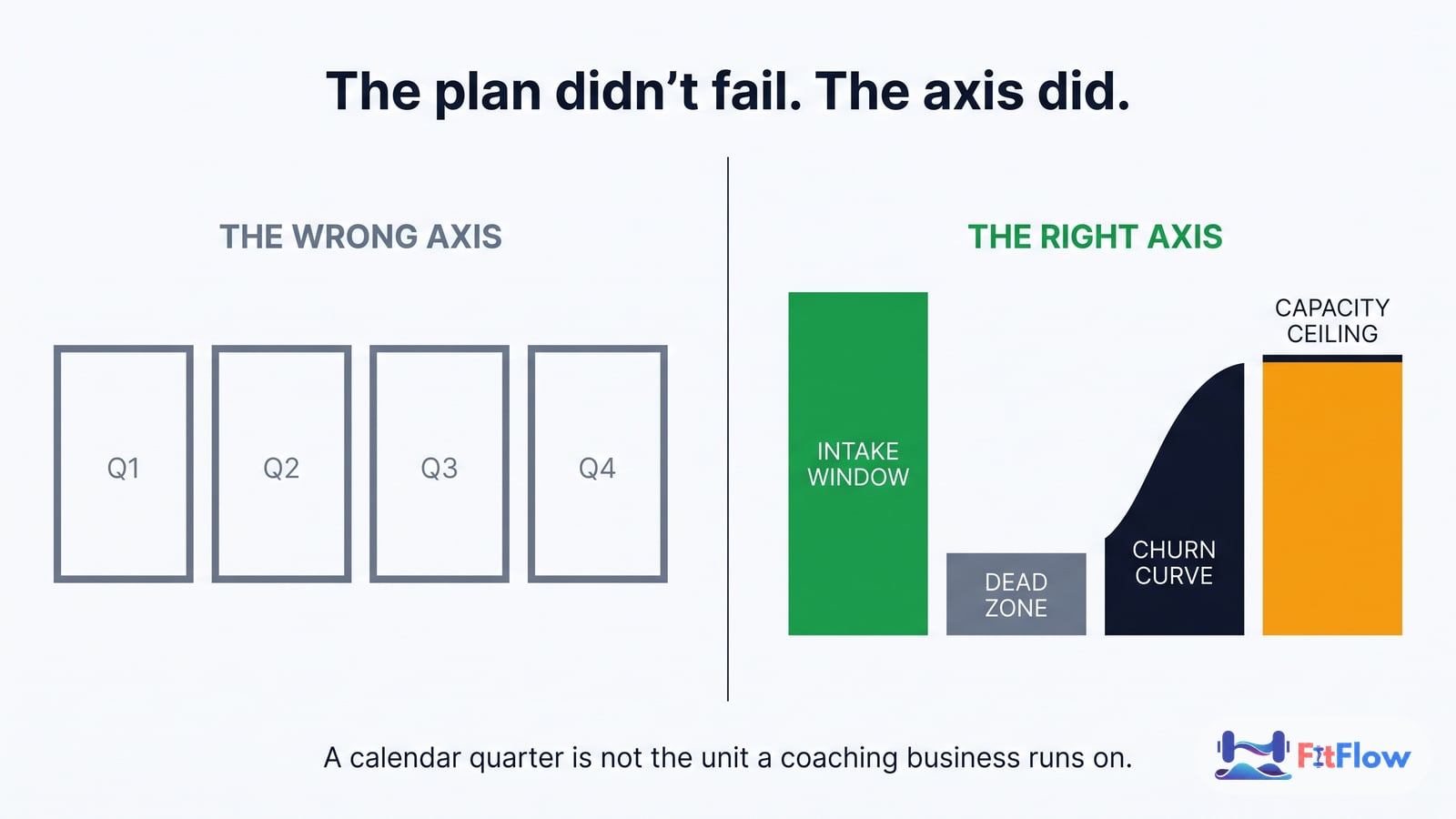
Coaches import corporate annual planning wholesale. OKRs. Calendar quarters. A flat twelve-month revenue line divided by twelve. It's the only planning grammar most of us have ever been shown, so it's the one we reach for.
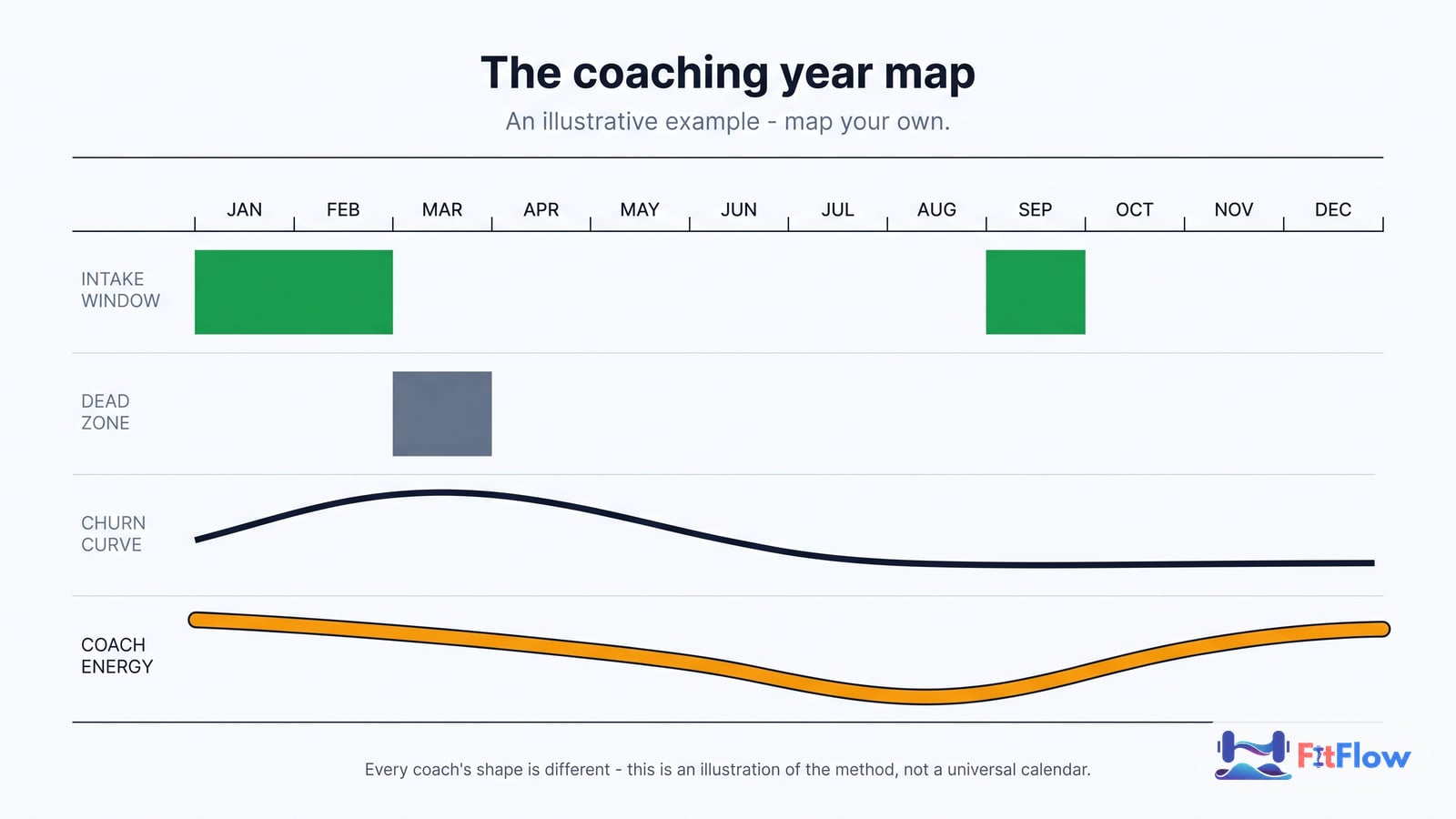
The problem is that a coaching year has a completely different shape. It is intake-driven, capacity-capped, and energy-dependent.
Intake-driven
You do not acquire clients evenly across fifty-two weeks. You have two or three real windows where people are actually looking, and stretches where nobody is. The January window is the obvious one, and it's real: 54% of US adults planning 2026 resolutions named health, fitness or exercise as a focus, ahead of financial goals at 49% (Health & Fitness Association, 2025). There is a recurring, documented demand signal sitting in that window.
There is also a well-known spring and summer falloff. I'm going to state that shape qualitatively and leave it there, because the specific surge-and-dip percentages that circulate for it trace back to a closed loop of vendor blogs citing each other and an industry body that never published them. Plan around the shape. Don't plan around a number nobody can source. Where those windows come from in the first place is a funnel question, not a planning one.
Capacity-capped
This is the one that breaks the imported model hardest. Your ceiling is not a market-size problem. It is a number of hours, and it belongs to one person. Not the aspirational number either — the real one, after the admin hours that already eat your week come off the top. Most coaches have never written that number down. It is very hard to plan a year against a ceiling you've never measured, and the wall you hit past thirty clients is that ceiling arriving whether or not you named it.
Energy-dependent
You will not be equally available in every month of your year, and a plan that assumes you will is a plan that budgets for a person who does not exist. This is not a soft observation. It is a capacity input, and it goes on the calendar with the same weight as an intake window.
Why the gym-owner version doesn't transfer
The gym-owner version of this advice doesn't transfer to you either, and it's worth saying why. Two-Brain Business runs an annual gym-building plan every year, and it is well-made for its audience: a month-by-month tactical calendar built around staff hiring, gym events, and a physical facility, with goal reviews scheduled twice a year. Their planning problem is a staffing problem — capacity is a schedule you build across several trainers, and slack is something you can redistribute. Yours is a personal capacity problem. There is nobody to redistribute to. That single difference changes what planning season has to produce, and no amount of borrowing a gym owner's calendar will close it.
The four-altitude planning stack
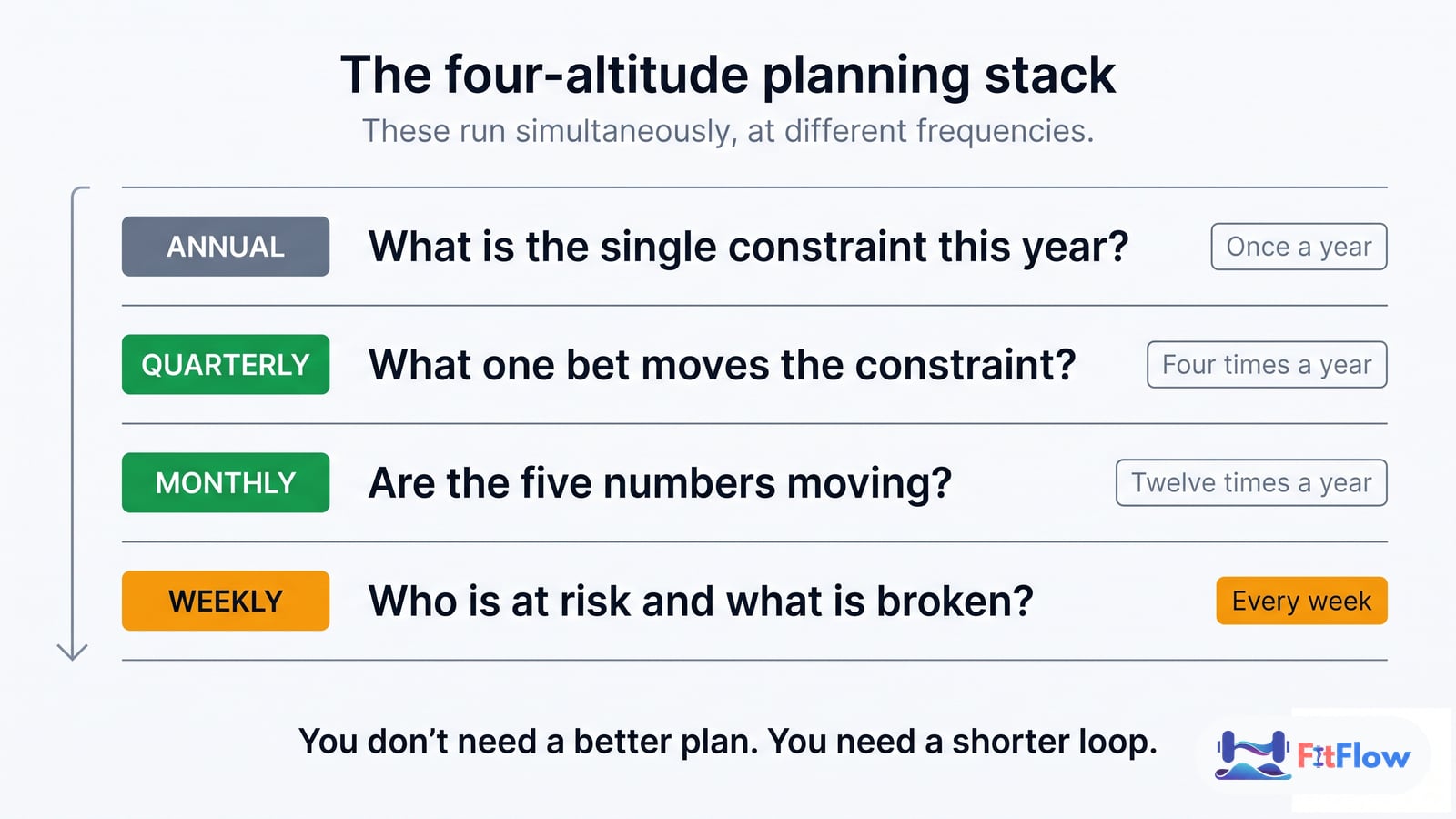
The mistake buried inside "annual planning" is that it sounds like one activity you do once. It isn't. There are four altitudes, they run simultaneously at different frequencies, and the annual altitude doesn't get replaced by the quarterly one — it just gets checked less often.
Altitude | The one question it answers | What it decides | Inputs | Time cost | The failure mode when you skip it |
|---|---|---|---|---|---|
Annual | What is the single constraint this year? | The thesis, the one constraint, the year map | The look-back audit, the honest capacity number, the churn curve, the intake calendar | A few hours, once a year | You plan against a calendar quarter instead of your actual capacity and intake shape — the single most common failure this post exists to fix |
Quarterly | What one bet moves the constraint? | The bet, its kill criterion, and the capacity it consumes | The annual constraint, this quarter's actual intake window, last quarter's result | An hour or two, four times a year | You run five initiatives at once, none gets enough attention to work, and none gets killed when it should |
Monthly | Are the five numbers moving? | Keep, adjust, or kill the current bet | The month's numbers against the quarter's kill criterion | 30–60 minutes, twelve times a year | Drift goes undetected for a full quarter instead of getting caught at the four-to-six-week mark |
Weekly | Who is at risk and what is broken? | Triage only, never strategy | This week's roster, this week's operational fires | 15–20 minutes, every week | Strategic decisions get made under weekly pressure — which is how a coach ends up changing pricing in a panic instead of on a schedule |
Read the bottom row again, because it's the one coaches most often collapse into the others. The weekly review is triage only. The moment strategy leaks into it, you are making pricing and capacity decisions inside the same forty minutes where you're worrying about a client who ghosted. That's the panic decision the whole stack exists to prevent.
You do not need a better plan. You need a shorter loop.
There's a reason the loop length matters and it isn't discipline. Stating a specific "if this happens, then I will do that" trigger in advance — rather than a general intention to keep an eye on things — produces a medium-to-large improvement in follow-through: d = 0.65 across 94 independent tests and more than 8,000 participants (Gollwitzer & Sheeran, 2006, Advances in Experimental Social Psychology). That's a general finding from psychology about goal pursuit, not a study of business planning, and I'm applying it here as a design principle rather than as proof. But it's the direct reason the quarterly and monthly altitudes need named kill criteria and dated triggers instead of a vague commitment to check in.
On frequency itself the evidence is thinner and I'd rather say so than dress it up. The closest thing to relevant data is organisational: Gallup reports employees are 3.6 times more likely to strongly agree they're motivated to do outstanding work when a manager gives feedback daily rather than annually (McLain & Nelson, Gallup, 2022/2024). That is employee-engagement research inside organisations with a manager–employee relationship. You don't have a manager. I'm using it as a directional analogy for why a rhythm tighter than semi-annual plausibly matters, and nothing more than that.
The annual planning cycle: five sessions
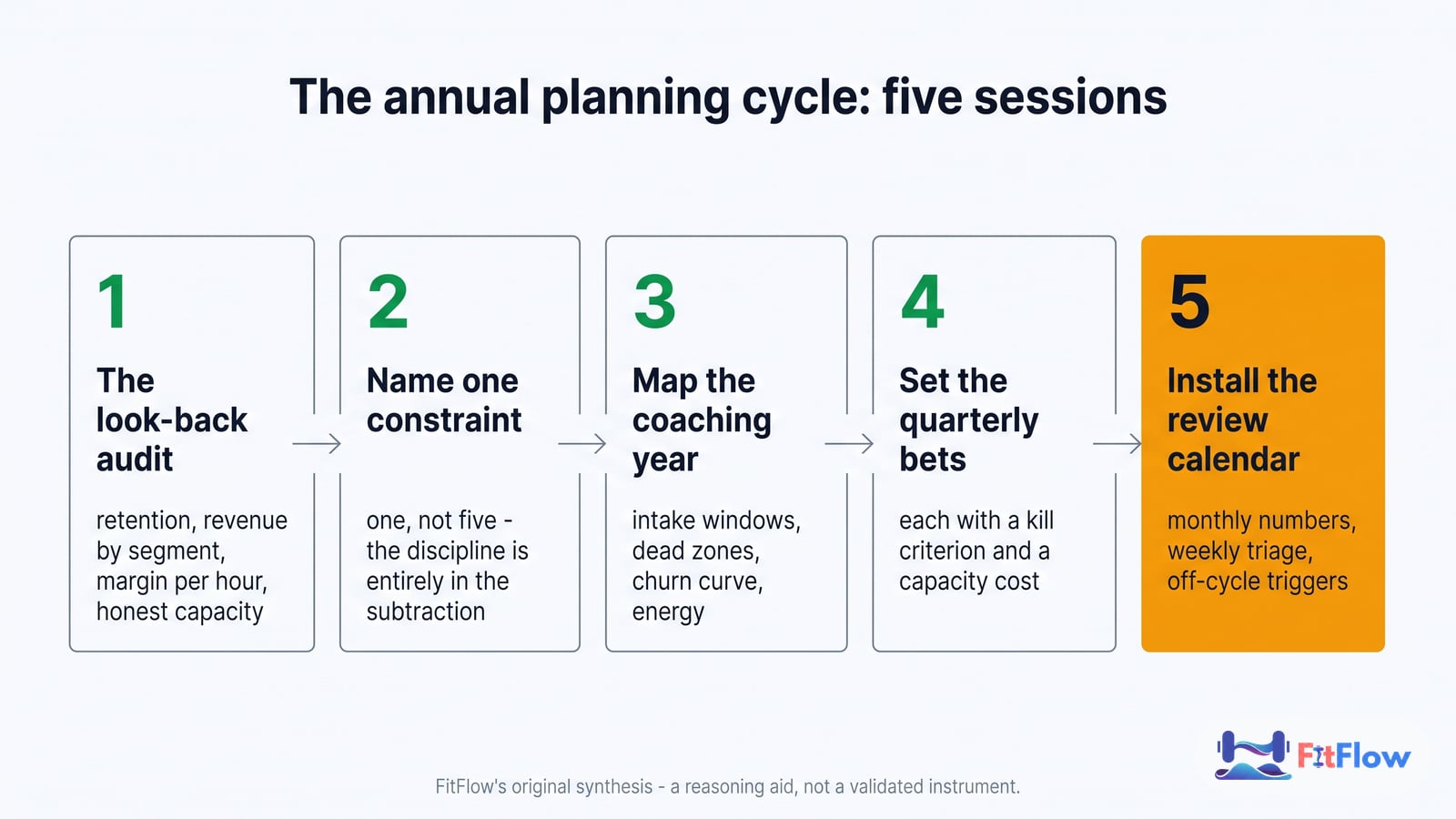
This is the workflow that produces everything in the table above. Five sessions. Run them across two weeks, not one afternoon — the gap between them is where the thinking actually happens.
Run the look-back audit. Before you set anything for the coming year: the retention curve, revenue by segment, and margin per available hour rather than revenue per session. Then the honest capacity number — not the aspirational one, the one that already has admin, sales calls and program-writing subtracted from it. This session produces inputs, not decisions. Resist deciding anything here. If the audit surfaces the churn shape and you want the detail, the month-three window is where it lives.
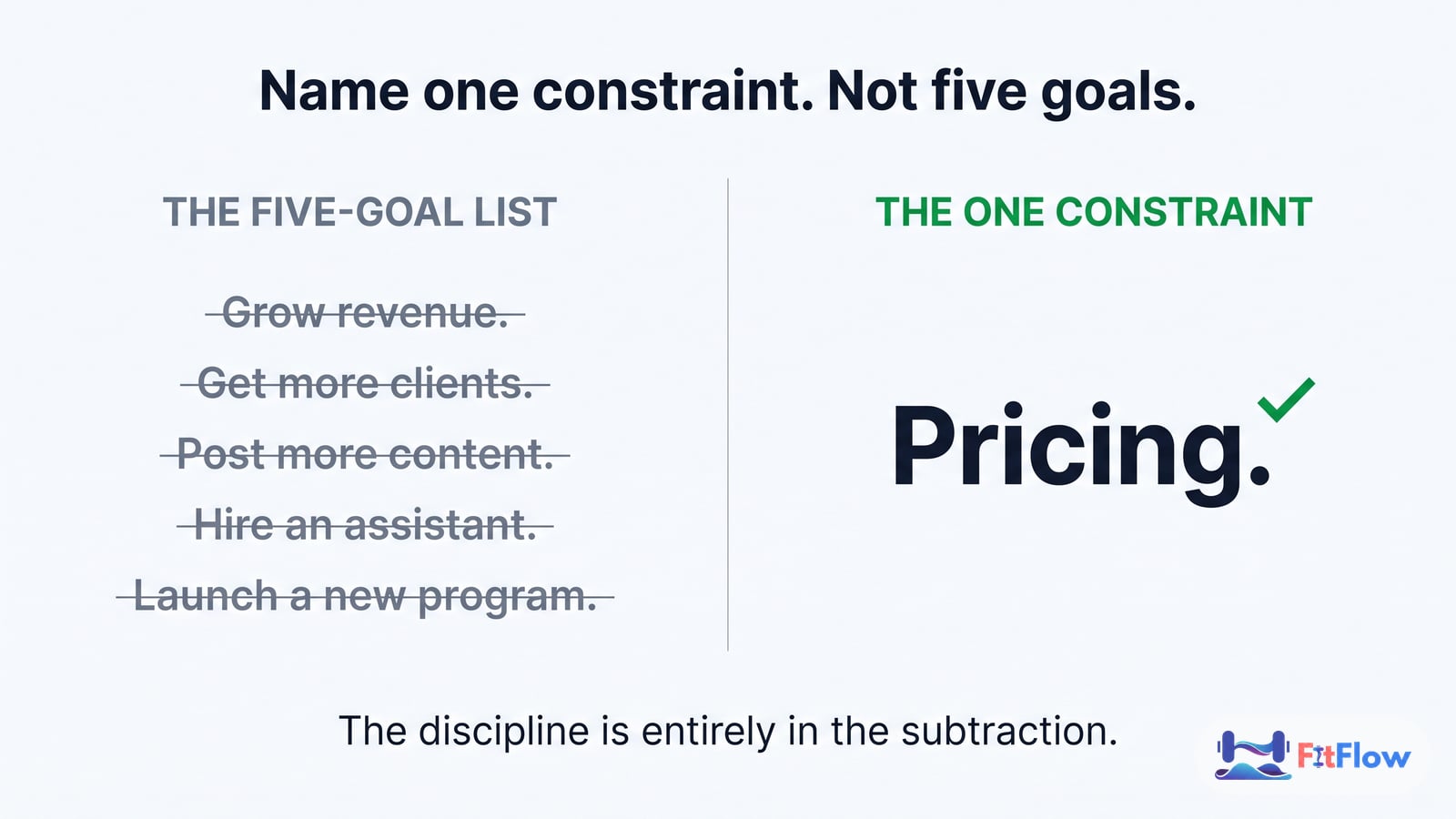
Name one constraint for the year. One. Not five. The discipline is entirely in the subtraction, and this is where the cycle most often goes wrong, by naming the wrong thing. "I need more clients" is the reflex, and it is frequently a pricing or positioning problem wearing an acquisition costume. "I need to work harder" is almost always a systems gap with a work ethic pinned to it. Sit with the audit for a day before you write the sentence.
Map the coaching year. Intake windows, dead zones, the churn curve, and your own energy and time off — placed on a real calendar before any target is set. Block the weeks you already know you'll be underwater. Mark the window where onboarding capacity gets consumed. This is where the seasonal shape of the business gets built into the plan instead of discovered in March.
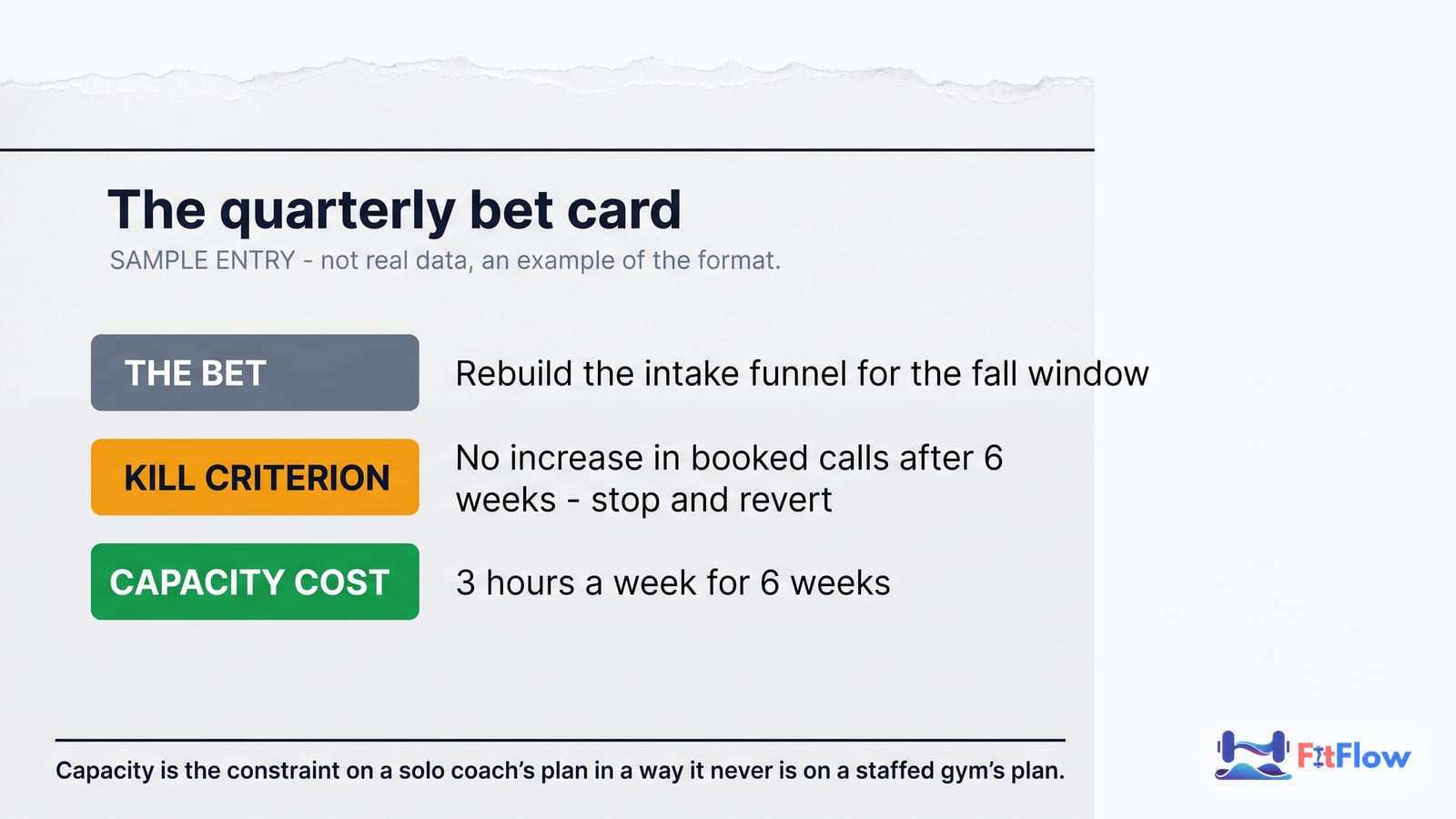
Set the quarterly bets against the constraint. One bet per quarter, each with two things written down: a kill criterion and the capacity it consumes in hours. The kill criterion is the sentence that lets you stop — "if this hasn't produced X by the end of month two, I stop and the hours go back." The capacity line is what keeps a one-person operation from silently overcommitting, and it's the field most coaches leave blank. Candidate bets usually come from decisions you've already been circling: a group offer versus one-to-one, a pricing correction, automating the admin layer, or a first assistant coach — which, note, consumes capacity for a quarter or two before it returns any.
Install the review calendar and the trigger list. Put the quarterly, monthly and weekly reviews on your actual calendar now, with dates, as recurring events you would not cancel on a client. Then write the trigger list: the named events that force an off-cycle replan regardless of what month it is. A churn spike. A lost anchor client. An intake window that doesn't open on schedule. A health event. When a trigger fires and the situation is genuinely severe, the rebuild path is a different playbook — but most triggers just move a review forward by three weeks.
Session 5 is the one almost every planning guide skips. It's also the only session that produces an artefact still doing work in August.
The Five Sessions You Just Read, as Eight Sections You Can Actually Fill In. The free planning pack is the artefact version of this cycle: the look-back audit as a worksheet with the arithmetic laid out, the year map as a six-row twelve-month grid, the constraint as a three-blank sentence, the quarterly bet as a five-field card, and the review calendar as seventeen events you can install in ten minutes. About three hours across two sittings, and you finish with a plan rather than a document about planning. Get the Free Planning Pack.
Where this post ends and three others begin
Posts on this subject drift into each other if nobody draws the lines, so here they are.
Neighbouring post | What it answers | What keeps this post distinct |
|---|---|---|
What breaks operationally past 30 clients, and the weekly client-delivery cadence that fixes it | Same word, different thing. That cadence is how often you touch a client's program after a growth threshold. This one is how often you review the business, on a calendar, whether or not anything is broken | |
A one-time, crisis-triggered 90-day rebuild for a business that has already failed | Rebuilding is emergency surgery. This cycle is the checkup meant to prevent needing it — recurring, non-crisis, run on schedule | |
What to measure, and why revenue per session is the wrong unit | That post prescribes the metric. This one prescribes when in the year you run it — session 1, not re-derived here | |
Group vs 1:1 margin math, underpriced offers, scaling past 50 clients | Specific structural business-model, pricing and capacity decisions | All three are candidate quarterly bets this cycle might select in session 4. This post is the scheduling layer above them, not a competing answer to any of them |
Where this is still uncertain — and what that means for your plan
I'd rather you run this cycle knowing exactly how much weight the evidence underneath it can hold. Here is the honest accounting.
The planning research is associational and moderated. It is not causal. Brinckmann and colleagues' 46-study meta-analysis found planning positively associated with performance, and found that association depends significantly on firm newness and cultural environment. Nothing in it licenses "write a plan, earn more" — not as a claim, not as an implication, not as a vibe. What it supports is narrower and still useful: across many small firms, the ones that planned tended to do better, more so in some contexts than others. If someone quotes that meta-analysis at you as proof that planning causes revenue, they have read the headline and not the moderators.
The goal-setting literature has a boundary condition that matters enormously here, and almost nobody in this genre mentions it. Specific, difficult goals reliably beat "do your best" — on simple-to-moderately-complex tasks the performer has already learned. On a complex task you haven't learned yet, the same intervention can hurt. Kanfer and Ackerman found that assigning a specific hard performance goal during a novel air-traffic-control simulation impaired skill acquisition relative to a "do your best" instruction, because goal-directed self-regulation competes for the same attention the learning needs (Kanfer & Ackerman, 1989, Journal of Applied Psychology).
That is a laboratory skill-acquisition study, not a study of coaching businesses, and I'm not going to pretend it's more than that. But the structural parallel is exact. A coach who has never mapped their own intake shape or measured their real capacity ceiling is, functionally, in the "hasn't learned the task yet" condition. Handing that coach a hard twelve-month revenue target is the intervention the boundary condition warns about. This is the actual evidence-based reason sessions 1 and 3 come before any target gets set — not a preference for thoroughness, and not me being fussy about order.
Individual variation exceeds the group effect, routinely. The 46-study planning meta-analysis and the 94-test implementation-intentions meta-analysis both describe averages. Your year is one year in one business, and it can sit well outside that average in either direction for reasons the aggregate data has no way to see. A health event. A local market shock. One anchor client leaving in a month you'd budgeted them into. The framework here is a reasoning structure. It is not a guarantee and it cannot be one.
Both frameworks in this post are FitFlow's original synthesis. The four-altitude stack and the five-session cycle are built from the planning-performance and implementation-intention literatures. Neither has been tested as a package. No study cited here evaluated them, and none of them was run on solo fitness coaches. Treat them as a reasoning aid with disclosed materials, not a validated instrument.
And the part that matters most if you're reading this at the end of a hard year: "the average firm does better with a plan" settles nothing about your year. It was never going to. Planning research describes central tendencies across many businesses, moderated by context, measured in aggregate. A coach whose plan didn't survive contact with reality is not a discipline-failure story, and a down quarter is not a character defect — it is one of the inputs session 1 exists to look at honestly. If the answer this cycle produces is that you have fewer available hours next year than last, that is a correct plan, not a smaller one.
Where planning stops being a coaching decision
The cycle in this post covers business strategy, capacity, and operating rhythm. It does not cover, and you should not try to resolve inside it: tax treatment of business income, entity structure (LLC vs sole proprietor vs S-corp), contract terms, or employee/contractor classification.
Those are legal and financial decisions with real, individual-specific consequences that depend on your jurisdiction, your revenue, and facts a blog post cannot see. They belong to a CPA or a business attorney. Not to your annual planning session, and not to a forum thread.
There is a version of this boundary that trips coaches up specifically, so I'll name it. Everything on the strategy side of the line is reversible cheaply — you can reprice, restructure an offer, or change your intake plan next quarter and absorb the cost. Everything on the professional side is not. A misclassification, a badly drafted contract, or the wrong entity choice compounds quietly for years and surfaces at the worst possible time, usually during a growth quarter when you have the least attention to spare. That asymmetry is the whole reason the line is drawn where it is.
This comes up more than you'd expect, because a good look-back audit surfaces exactly these questions. A revenue level that changes which entity structure makes sense. A quarterly bet involving a first hire, which raises a classification question before it raises anything else. When that happens, the correct move inside this framework is clean: name it as a trigger for a professional consultation and put it on the trigger list from session 5. That's a planning output. Reasoning it out alone is not.
You don't need a better plan. You need a shorter loop.
The coach with the sheet taped above his desk didn't need a better number on it. He needed the number to be checkable, on a date, against a criterion he'd written before he was emotionally involved in the answer.
That's the whole move. Everything in this post — the four altitudes, the five sessions, the kill criteria, the trigger list — exists to shorten the distance between a plan going wrong and you finding out. In January, a wrong plan costs you nothing. In March, it costs you a quarter. In December, it costs you the year and you write next January's plan from the same blind spot.
So don't wait for January. The look-back audit works in September. Pick one session, put it on the calendar this week, and let the annual planning cycle for coaches be a loop you're already inside rather than a document you're about to write.
You Don't Need a Better Plan. You Need a Shorter Loop — Here Is the Loop, Fillable. Everything above, as eight sections you work through in about three hours: the look-back audit with the honest capacity arithmetic, the twelve-month year map, the constraint statement and its misnaming diagnostic, four quarterly bet cards with written kill criteria, the four review agendas with verbatim prompts, the five monthly numbers with a definitions lock, and ten replan triggers with thresholds you set while nothing has gone wrong. Free, no strings. Get the Free Planning Pack.